Thursday, March 26, 2026

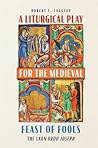
2026 #11 A Liturgical Play for the Medieval Feast of Fools: The Laon Ordo Joseph (Lagueux)


A Liturgical Play for the Medieval Feast of Fools: The Laon Ordo JosephA Liturgical Play for the Medieval Feast of Fools: The Laon Ordo Joseph by Robert C. Lagueux
My rating: 4 of 5 stars

Full disclosure: the author is a friend and colleague/boss.

That said, I read this on its own merit (and NOT at the behest of the author), as I am a self-described "medievalist groupie" (in terms of musicological specialty) and I found myself entranced by the detailed contextualization of this medieval drama. Lagueux devotes much needed attention to the "gloss" and how it operates dramaturgically, supported by well-conceived suppositions regarding the performance of the work in Laon. The situation is very nuanced, and he makes a convincing case for multiple levels of Biblical exegesis that play out in the Ordo Joseph. Most fascinating is the symbology and the role reversal of various clerics of the Church in service of enacting social inversion. Unlike the music associated with Florentine Carnival (e.g. canti carnascialeschi), in this context, Lagueux notes, "...inversion does not require mad revelry." (88). His investigation of the Ordo Joseph supports his claim that, "...meaningful inversion can and does occur in the context of an ecclesiastically sanctioned undertaking." (88)

Equally valuable and intriguing is the author's "reconstruction" or after Peter Jeffery, "re-envisioning" of the music, based on thoughtful and detailed consideration of the available chants (in Laon 263, many for Epiphany) that would work for the rhythms and rhyme schemes of the text. Lagueux also considers intertextual significance, such as the use of the sequence In sapientia (fol. 131v-132v) which offers a Reader's Digest view (my words) of the life of Christ, reflecting both the commemoration of Epiphany as celebrated in the Middle Ages, as well as dialoguing with christological connections in the story of Joseph.

View all my reviews

Challenges on Storygraph (@rebcamuse):
2026 Reading Goals 11/60
Tackle your Physical TBR 2026: no.7

Wednesday, March 18, 2026

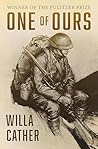
2026 #10 One of Ours (Cather)


One of OursOne of Ours by Willa Cather
My rating: 4 of 5 stars

I was once asked why I join different reading challenges, and it is to have opportunities like reading this book. Male protagonist. Coming of age story. Wartime (WWI). The combo of all of these put together would normally put me off, but it won the Pulitzer Prize in 1923 (thereby checking off two different challenges I've signed on for), and this was my first Willa Cather (and probably won't be my last). When Cather was writing in 1922, it was a mere four years after World War I ended, so for her time it was contemporary fiction (for mine, historical). Claude Wheeler, a young Nebraskan farmer, searches for his identity as a student, as a farmer's son, as a friend, as a husband, as a soldier, and not least as an American. Cather has a gift for making you care about sunsets and wheat fields in the same measure as young men marching off to war because she weaves these things together with intentionality, always teetering on the brink of idealism to remind you it is there, but also with a certain pragmatism to keep us with one foot in reality. The book is harshly beautiful, if I can describe it thus. Cather allegedly ascribed to Claude some aspects of her own personality, along with that of her cousin G.P., who was killed in action during WWI. The result is a protagonist with whom we can sympathize, even when he makes poor decisions (or maybe ESPECIALLY when he does), and for whom we cheer in his idealism and sense of resolve.

The book is not a "war novel" -- the war only makes a real entrance with descriptions of trench warfare and the like toward the end of the book. There are moments where Cather's critique shines through, like when Ernest tells Claude: "You Americans are always looking for something outside yourselves to warm you up, and it is no way to do. In old countries, where not very much can happen to us, we know that, --and we learn to make the most of little things." (88). And other times she zooms out from the story to remind us of the entire Zeitgeist. As news of the war becomes more noted by members of the Wheeler family, Claude's mother goes up to the attic to find a map of Europe -- "a thing for which Nebraska farmers had never had much need."(246). Cather follows this with: "But that night, on many prairie homesteads, the women, American and foreign-born, were hunting for a map." (246). There are so many moments like this.

Cather received criticism (from the likes of Sinclair Lewis and H.L. Mencken) for romanticizing war, and that's perhaps a valid critique. However, with almost a century of hindsight, I read it differently. The romanticization is really about Claude and his idealism (and that of his soldier companions). The emotional distance Cather employs in her descriptions of some of the brutalities of war creates an almost journalistic narrative, and she reserves her emotional energy for moments of human interaction. I don't think Cather is suggesting/advocating war as a solution for youthful searching for purpose, but I think she is suggesting that World War I offered something particular for certain young American men who became disillusioned with what was available on their home turf.


View all my reviews

Challenges on Storygraph (@rebcamuse):
2026 Reading Goals 10/60
#192030 Challenge: 1922


Monday, March 16, 2026

2026 #9 Rumour of Heaven (Lehmann)


Rumour of Heaven
by Beatrix Lehmann
My rating: 3 of 5 stars

Beatrix Lehmann (1903 - 1979) was an English stage actress, well-known in her own right, and sister of novelist Rosamond Lehmann (1901 - 1990). Rumour of Heaven (1934) was Beatrix's second novel, and it initially starts out strong, centering around the Peacock family and its troubled matriarch, former dancer Miranda Mirova. There are many themes to explore here including mental illness and ideas of isolation. We are prepared for a novel about the children--Clare, Hector, and Viola--all of whom survive, but hardly thrive, at the remote country estate known as Prince's Acre. These three characters are fairly vivid, as is Mrs. Humble, the housekeeper. The father flits in and out of the mist.

The middle of the book feels a bit of a misstep. The focus shifts to two (well, three, actually) new strangers who come to Prince's Acre. Gillian Tindall's introduction to the Virago edition notes that Max Ralston is a "Conradian character" and he might have been, but he fizzles out of the narrative, so I suppose in that way he operates as a Kurtz a bit, but I would have liked him to be a bit more present and Paul less so. Once this secondary set of characters enters, things feel a bit off the rails and the ending speeds up with a bit of desperation to tie things together.


View all my reviews
Challenges on Storygraph (@rebcamuse):
2026 Reading Goals 9/60
Tackle your Physical TBR 2026: no. 6
#192030 Challenge: 1934

Thursday, March 12, 2026

2026 #8 Raising Hare (Dalton)


Raising Hare: A MemoirRaising Hare: A Memoir by Chloe Dalton
My rating: 4 of 5 stars

We can start with the fact that I've never really given a lot of thought to rabbits and hares being distinct animals, although it registered somewhere in the back-burner of my brain. I think I'm probably not alone. Dalton's memoir sets out to change that, at least in passing. When she encounters an abandoned leveret (baby hare), her life is forever changed (and that isn't hyperbole). Yes, it is a story of one woman and and at least at first, one hare. But it is also a very thoughtful meditation on the fragile ecosystem and how humans must struggle to maintain some sort of precarious equilibrium, as the balance was long ago upset. Dalton is transparent about her struggles and her questions (of herself, of the relatively isolated world of hare-related knowledge, of her little furry friend(?)). It is this questioning that keeps things from falling into the trap of an overly saccharine and anthropomorphized tale. She reels us in with her narrative in such a way that we find ourselves holding our breath as she writes of circling hawks and various other garden predators, any of whom would like a lunch of leveret. She introduces us to previous chronicles offered by hunters, poachers, and poets alike, who offer musings and (mis)characterizations of these enigmatic animals. Dalton seems conscious of adding her voice to the small trove of information so that sometime in the future, another leveret-encounterer might turn to her memoir for assistance.

The hare is never named and this is ultimately an act of respect, but, also, one suspects, an act of self-preservation. While Dalton works hard not to domesticate the animal, there is something else -- some undefined opportunity to commune (sort of) with another species. I picked this up in the airport because I had heard about it and I wanted something short enough to finish over the course of two shorter flights. I might not have gotten around to it otherwise, so I'll thank not only the airport bookstore, but also Denise Nestor's gorgeous illustration on the front cover (and those that are included inside the book as well). It is truly a delightful and tender read.

View all my reviews