Tuesday, June 30, 2026

2026 #16 State of Wonder (Patchett)


State of WonderState of Wonder by Ann Patchett
My rating: 4 of 5 stars

"There was no clear point of loss. It happened over and over again in a thousand small ways and the only truth there was to learn was that there was no getting used to it." (269)

Patchett is one of my favorite writers because she drops lines like this that carry heartfelt truths that transcend the specific narrative of the story. State of Wonder explores ethics, love, and what drives us as humans. The protagonist, Marina Singh, is on a hero's journey into the heart of the Amazon, but her return, and indeed her journey, morphs as the book progresses, making this an engaging adventure on top of a deeper character study. I do love endings that are happy, yet not ("bittersweet" doesn't really work here), but I could have done without the "comfort sex."

The moral high ground is a series of shifting tectonic plates in this novel, and that's what makes it such a wonderful read.

View all my reviews
Challenges on Storygraph (@rebcamuse):
2026 Reading Goals 16/60
Tackle your Physical TBR 2026: no. 10
#192030 Challenge: 2011

Monday, June 22, 2026

2026 #15 Harlem Shuffle (Whitehead)


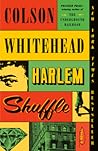
Harlem Shuffle (The Harlem Trilogy, #1)Harlem Shuffle by Colson Whitehead
My rating: 4 of 5 stars

For reasons not totally clear to me, it took me a LONG time to get into this book. In truth, it was only Part 3 that really engaged my interest, but I think that had a lot more to do with the fact I was traveling and unfocused. I loved The Underground Railroad so I had big hopes here, and when I sat down and read carefully, I felt much more connected to Ray Carney and the book. So I'm probably going to go back and read the first two parts at some point.

This historical backdrop isn't easy (partially because some of the same issues persist), but the wry narrative works really well, and Whitehead peppers in scenic references to this historical landscape: the recently completed Pan Am building (now MetLife), the partially completed Lincoln Center, the demolition and clearing that made way for the World Trade Center. That alone cast an eerie pall over the last few pages of the book. I also thought the 1964 Harlem Riot was integrated in a very real way--in how it impacted real folks "on the ground". As someone who marks the 1992 Los Angeles riots as a formative experience of my life, I recognized the complex and wide variety of feelings from the city's inhabitants. Like the emerging space for the WTC, the weight that history repeated/repeats itself makes this way more than a "suspenseful crime thriller" (NPR blurb in book).

The detachment from violence and the sort of "everyman" qualities of the protagonist are very effective in conveying a sense of realism rather than sensationalism. Strangely, Pepper became my favorite character -- or at least Pepper's later interactions with Ray.

And there are moments of absolutely spectacular dry humor -- Ray's noting of the furniture in the board room in the final showdown, his complete "payment" to Pepper, descriptions of Aunt Millie: "She could have kicked the ass of a druggie or the ne'er-do-well nephew of her upstairs neighbor--her mastery of her weapon of choice, the hairbrush, went unchallenged..." (246). I also loved the descriptions of some of the less scrupulous characters: "Miami Joe was not a law-abiding sort and had no love for its earthly muscle..." (96).

Whitehead's writing is so clever in how it packs character into description: "[Carney] ran like a kid convinced that the whole grown-up world with its entire grown-up might was going to beat him silly." (291)

Or another favorite:

"No, its best not to hear your grown friends talked to the way Ambrose Van Wyck addressed his son. The humiliation splashes everywhere. You'll get it on you and it'll become your own bad time, the bloody resurrection of your own childhood sadnesses." (270)

Despite the rough beginning, I'm sold enough to read Crook Manifesto and my four stars acknowledges my own fault in not engaging with the first two parts of the novel.

View all my reviews
Challenges on Storygraph (@rebcamuse):
2026 Reading Goals 15/60
Tackle your Physical TBR 2026: no. 9

Tuesday, June 16, 2026

2026 #14 1Q84 (Murakami)


1Q84 (1Q84, #1-3)1Q84 by Haruki Murakami
My rating: 3 of 5 stars

Ok, there's a lot to say here, but I'll try to keep it brief. Really this is 3.75 for me, and in places, a solid 4 stars. But for such a long book, I needed more consistency of those 4 star moments. I'm tenacious, which is why I stuck with it, but there were definite times that threatened a "DNF". This was my first Murakami, and I get the impression that it is probably not the best gateway drug (much in the way that Tristan und Isolde was NOT the best "first opera" for me to analyze in college). It was long in a way that I did not appreciate. I feel this way about Robert Schumann's music sometimes.

The premise is VERY intriguing and I will say, if you are not into magical realism or anything related, don't bother with this. I appreciated the lessons about cults. I loved the characters of the Dowager, as well as Tamaru, and weirdly enough, Ushikawa. Aomame had her moments for me, and Tengo, too, but not enough for me to feel satisfied by the ending (when I got there, after 6 renewals on Libby). I also loved Fuka-Eri's "usual style free of question marks."

I read some reviews because I was a bit mystified. Some extoll Murakami's pacing. I cannot agree. There were places that felt like an endurance test. The intertextual references kept things interesting and nerdy-- I need to put together a 1Q84 playlist (or find one that inevitably already exists). I will be forever indebted to being introduced to Janáček's Sinfonietta because of this book.

There seems to be a weird obsession with pubic hair--sometimes ACTUAL pubic hair, and sometimes used as a comparative for head hair (see: Tengo, Ushikawa). Perhaps there's some deeper significance of which I'm not aware -- if so, please let me know. I found the entire three volumes weird in the sex arena, and in some places downright disturbing. I am not titillated in the least by non-consensual sex, even in the service of acting as a spiritual conduit.

Is it imaginative? YES. There are places that felt like imagination for imagination's sake, but others that took me on a journey. The ending was a disappointment, although I understand the lack of resolution to be understood as "infinite possibilities." Is it a love story? Sort of. It lacks the maudlin sentimentality of "Somewhere in Time," but also didn't make me care enough about the two main protagonists.

It is certainly a down-the-rabbit-hole experience, but I feel I would have been happy with something a third of the total length. I've reached out to friends who are fans of Murakami because, as I said, I have the distinct impression that this may not have been the best choice of a "starter" in terms of his oeuvre. I'm definitely game for reading more of his work, but this was more of a marathon than I wished.

View all my reviews