Monday, November 9, 2026

2026 #40 The Winter People (McMahon)


The Winter PeopleThe Winter People by Jennifer McMahon
My rating: 3.5 of 5 stars

I was looking for something fun and spooky (I started it just at the end of October), and I liked that it was set in Vermont. The overall multi-generational concept was intriguing, but it didn't necessarily play out in a realistic way. There were a few plot holes, but generally I stayed interested. Candace was my least favorite character because she seemed to come out of nowhere, and yet was a major plot driver for the last part of the book. I also thought she was overwritten. While it kept me entertained, I felt unsettled (not in a good way) by the choices of Alice, and the plot twist in regard to another character felt unfair and a bit of a letdown, although I suppose it was anti-cliché (which I approve). I thought Ruthie was a pretty good protagonist, and McMahon doesn't overdo the angsty teenager stuff and we do see her mature. I was actually pleasantly surprised that we didn't get a soap opera from her with the big reveal.
There was a good chunk of the book that would have been 4 stars for me, but then the ending killed it. It felt like the editor said "enough is enough -- wrap this up" and I was just left feeling deflated and annoyed.

View all my reviews

2026 Reading Goals: 40/60

Sunday, November 1, 2026

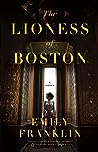
2026 #39 The Lioness of Boston (Franklin)


The Lioness of BostonThe Lioness of Boston by Emily Franklin
My rating: 3.75 stars

My favorite thing about this book was the voice of Isabella Stewart Gardner. Told in first person, the narrative is beautifully reflective of historical Isabella as she navigates social isolation, and finds her way to being a patron and curator. As with any historical fiction, there are liberties, and Franklin does a good job of describing them in the afterword. I did question the choice to go forward with certain intimate details which, as far as I know, is just speculation. I look forward to reading Natalie Dykstra's Chasing Beauty: The Life of Isabella Stewart Gardner to more clearly separate fact from fiction.
My biggest complaint about the book was the superfluous "name dropping." Franklin says that the art show in Paris took place, but Isabella was not there, and the whole scene felt very much a who's who of Impressionism rather than something that enriched the narrative. There were times were the historical references to art works in the ISG Museum felt a bit overwrought, and the dinner parties were likewise too focused on illuminating a panoply of historical figures. Most enriching was her (fictionalized) correspondence with Charles Eliot Norton, and the importance of the Dante Society, as well as her interaction with John Singer Sargent, whose portraits are especially significant to those who know the museum. There were some others as well, but without having a secure sense of the history, it was hard to parse the significant figures from the incidental ones.

Generally an entertaining book, particularly as I live in Boston and enjoy the ISG Museum as one of our real treasures. It is fun to think about how she might have been, and Franklin tries to bring her closer to our hearts as a woman trying to carve out a space for herself (in this case, Fenway Court, as it was called) in a world of art and culture very much commandeered by men.

View all my reviews

2026 Reading Goals: 39/60

2026 #38 Psalm for the Wild Built - Monk and Robot #1 (Chambers)


A Psalm for the Wild-Built (Monk & Robot, #1)A Psalm for the Wild-Built by Becky Chambers
My rating: 4 of 5 stars

4.5 stars! Admittedly, this started slowly for me, but I think it is largely due to the fact that the only time I really give myself to read is right before bed. It was perhaps the perfect follow-up to my reading of _Siddhartha_ and strangely similar. Sibling Dex, a non-binary tea monk who may be having a bit of a crisis, is very much a seeker like Hesse's Siddhartha in that they feel a gap in the life they have chosen. Unlike Siddhartha, however, Dex has a companion--the robot Mosscap. I'm not giving anything away given the name of the series.

Once Mosscap entered the narrative I became much more invested. There's a tremendous beauty to this book. The theology and history that Chambers builds is very intriguing. We learn of the "Factory Age" that we might assume has some parallels to our current Anthropocene. Robot consciousness develops (as "an accident") and there is a climactic event/transition wherein robots decide to leave and humans revert to a more agricultural lifestyle, informed by a pantheistic (?) religion, that seems more akin to some indigenous understandings/approaches of/to religion. The world is not devoid of mechanics, but what exists is there in the service of recycling and renewing, such as Dex's greywater filter that they use in their mobile shower as they pedal across the land with their wares.

Oh could we ever use tea monks now. "Everybody needed a cup of tea sometimes. Just an hour or two to sit and do something nice, and then they could get back to whatever it was." (88%).

The book, largely through Mosscap, asks us to consider the purpose-driven life and how much of that defines our humanity. How much do we miss of the exhilaration of consciousness?

This is a book to read with intention, not as you drift off to sleep.

View all my reviews

2026 Reading Goals: 38/60