Showing posts with label in translation. Show all posts

Tuesday, June 16, 2026

2026 #14 1Q84 (Murakami)


1Q84 (1Q84, #1-3)1Q84 by Haruki Murakami
My rating: 3 of 5 stars

Ok, there's a lot to say here, but I'll try to keep it brief. Really this is 3.75 for me, and in places, a solid 4 stars. But for such a long book, I needed more consistency of those 4 star moments. I'm tenacious, which is why I stuck with it, but there were definite times that threatened a "DNF". This was my first Murakami, and I get the impression that it is probably not the best gateway drug (much in the way that Tristan und Isolde was NOT the best "first opera" for me to analyze in college). It was long in a way that I did not appreciate. I feel this way about Robert Schumann's music sometimes.

The premise is VERY intriguing and I will say, if you are not into magical realism or anything related, don't bother with this. I appreciated the lessons about cults. I loved the characters of the Dowager, as well as Tamaru, and weirdly enough, Ushikawa. Aomame had her moments for me, and Tengo, too, but not enough for me to feel satisfied by the ending (when I got there, after 6 renewals on Libby). I also loved Fuka-Eri's "usual style free of question marks."

I read some reviews because I was a bit mystified. Some extoll Murakami's pacing. I cannot agree. There were places that felt like an endurance test. The intertextual references kept things interesting and nerdy-- I need to put together a 1Q84 playlist (or find one that inevitably already exists). I will be forever indebted to being introduced to Janáček's Sinfonietta because of this book.

There seems to be a weird obsession with pubic hair--sometimes ACTUAL pubic hair, and sometimes used as a comparative for head hair (see: Tengo, Ushikawa). Perhaps there's some deeper significance of which I'm not aware -- if so, please let me know. I found the entire three volumes weird in the sex arena, and in some places downright disturbing. I am not titillated in the least by non-consensual sex, even in the service of acting as a spiritual conduit.

Is it imaginative? YES. There are places that felt like imagination for imagination's sake, but others that took me on a journey. The ending was a disappointment, although I understand the lack of resolution to be understood as "infinite possibilities." Is it a love story? Sort of. It lacks the maudlin sentimentality of "Somewhere in Time," but also didn't make me care enough about the two main protagonists.

It is certainly a down-the-rabbit-hole experience, but I feel I would have been happy with something a third of the total length. I've reached out to friends who are fans of Murakami because, as I said, I have the distinct impression that this may not have been the best choice of a "starter" in terms of his oeuvre. I'm definitely game for reading more of his work, but this was more of a marathon than I wished.

View all my reviews

Tuesday, December 30, 2025

2025 #56 Signs Preceding the End of the World (Herrera)


Signs Preceding the End of the WorldSigns Preceding the End of the World by Yuri Herrera
My rating: 4 of 5 stars

A timely read, the book offers a "hero's journey" of Makina, a Mexican woman sent by her mother to find her brother on the 'other side', while also carrying a "package" for a certain Mr. Aitch. While something is always lost in translation, I think Lisa Dillman worked hard (at least according to the Translator's Note) to pick up on the craft of Herrera's writing. The style reminded me of both Italo Calvino and José Saramago, the former of whom I love, and the latter I'm still trying...

Pay attention to the beginning as it is what helps situate this Campbellian monomyth. There's a lot of subtlety in the book, and certain moments almost seem like meta-narrative: "Using in one tongue the word for a thing in the other makes the attributes of both resound: if you say Give me fire when they say Give me a light, what is not to be learned about fire, light and the act of giving? It's not another way of saying things: these are new things." (67-68).

Yes, it is a book about migration, but also more metaphorical border crossings.

View all my reviews

Sunday, November 2, 2025

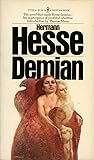
2025 #46 Demian (Hesse)


Demian: The Story of Emil Sinclair's YouthDemian: The Story of Emil Sinclair's Youth by Hermann Hesse
My rating: 3 of 5 stars

First published in 1919, I think Demian would have hit me differently had I been reading it in the postwar ethos. Unlike Narcissus and Goldmund, this felt rather dated, but intriguing enough as a love child of Catcher in the Rye and the Sorrows of Young Werther with a dash of Nietzsche and Freud thrown in.

The book was originally published under the alias "Emil Sinclair" who is, in fact, the novel's protagonist. The book isn't really so much about Max Demian, the weirdly prophetic and enigmatic figure who pops up in Sinclair's life, but more about Sinclair's psychological and spiritual growth---or journey (that might be more apt). Hesse isn't subtle about light vs. dark, but what is refreshing about the story is that the two aren't diametrically opposed, or at least that seems to be the insinuation. Women are used as functional figures rather than significant characters, and I can't help but think that the beautiful Beatrice was a nod to Dante and Frau Eva seemed connected to Eden's Eve. Given that one of Demian's first expositions is a reinterpretation of Cain and Abel's story, this sort of intertextuality wouldn't surprise me. Sinclair's dreams are fairly central features to the story, and Hesse's exposure to Freud and Jung is laid bare: "...dreams that had emanated from the unconscious, of dreams in which humanity groped after its intimations of future potentialities" (123).

Sinclair is young and impressionable, at least at first, and Demian rocks his world with his individualistic interpretation of Biblical stories and way of living. The organist Pistorius is a transitional figure, as Sinclair is still looking for a mentor, but also feeling the tug of a need to make his own path. When Sinclair stays with Demian's mother (Frau Eva), things get a bit Oedipal, and fairly cultish. It is hard to connect to Sinclair, who seems to become increasingly Übermenschisch (in some ways), but he's interesting enough (as we are privy to his every rumination and dream). I'd reckon that this would not be the best introduction to Hesse for the uninitiated, but a worthwhile read for those who loved his other works.

View all my reviews

FTL2025 6B challenge DEI Deconstructed<-------------Demian ---------> Night Watch (Phillips)

Wednesday, July 16, 2025

2025 #28 The Book Censor's Library (Al-Essa)


The Book Censor's LibraryThe Book Censor's Library by Bothayna Al-Essa
My rating: 4 of 5 stars

While not totally subtle in its satire, Al-Essa's novel succeeds with a dark whimsy befitting Alice and Wonderland, which serves as larger reference for the story in more ways than one. But Al-Essa's looking glass is perhaps more than it seems, and we are easily manipulated into caring for characters even though they bear titles, like stock figures, rather than names. The "Everyman" approach keeps a strange distance, until we come to understand the power of our own imaginations with an ending that has been described as a "narrative rupture" or a "twist worthy of Kafka." The ending made me a bit cranky, initially, but the more I thought about it, it seemed perfect to serve Al-Essa's true narrative, with its hanging threads and all.

View all my reviews

Monday, July 27, 2009

50BC09 #11: The Elegance of the Hedgehog

The Elegance of the Hedgehog The Elegance of the Hedgehog by Muriel Barbery

A RESOUNDING FIVE STARS!


It is rare that I am so enticed by the back cover of a book that I pick it up in the store, but when I read the synopsis of The Elegance of the Hedgehog, I did just that. This book is now in my top five favorite books of all time.
The characters are enchanting, yet real. While I found twelve-year-old Paloma to be a bit overwritten at times, her fellow protagonist, Madame Michel, is so engaging and at once heartbreaking and loveable, that the precociousness of Paloma can be forgiven.
And the book is heartbreaking, but not because of the tragedies, but because of the joy. Life, in all its guises, leaps off the pages and finds places in the reader's heart that may have long been hidden. It is that kind of book.
I'm reticent to say "everyone should read this book" because I think it resonated with me according to my life experiences and my personality (I am Paloma and Madame Michel both). I'd give it a try, however. And I'd stick with it...if the intellectual meanderings of Paloma and Renée get tiresome, read quickly until Ozu enters the scene. Then, if you liked The Time Traveler's Wife, I think you'll find the rest of the book to be utterly compelling.