Showing posts with label music. Show all posts

Thursday, March 26, 2026

2026 #11 A Liturgical Play for the Medieval Feast of Fools: The Laon Ordo Joseph (Lagueux)


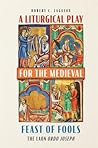
A Liturgical Play for the Medieval Feast of Fools: The Laon Ordo JosephA Liturgical Play for the Medieval Feast of Fools: The Laon Ordo Joseph by Robert C. Lagueux
My rating: 4 of 5 stars

Full disclosure: the author is a friend and colleague/boss.

That said, I read this on its own merit (and NOT at the behest of the author), as I am a self-described "medievalist groupie" (in terms of musicological specialty) and I found myself entranced by the detailed contextualization of this medieval drama. Lagueux devotes much needed attention to the "gloss" and how it operates dramaturgically, supported by well-conceived suppositions regarding the performance of the work in Laon. The situation is very nuanced, and he makes a convincing case for multiple levels of Biblical exegesis that play out in the Ordo Joseph. Most fascinating is the symbology and the role reversal of various clerics of the Church in service of enacting social inversion. Unlike the music associated with Florentine Carnival (e.g. canti carnascialeschi), in this context, Lagueux notes, "...inversion does not require mad revelry." (88). His investigation of the Ordo Joseph supports his claim that, "...meaningful inversion can and does occur in the context of an ecclesiastically sanctioned undertaking." (88)

Equally valuable and intriguing is the author's "reconstruction" or after Peter Jeffery, "re-envisioning" of the music, based on thoughtful and detailed consideration of the available chants (in Laon 263, many for Epiphany) that would work for the rhythms and rhyme schemes of the text. Lagueux also considers intertextual significance, such as the use of the sequence In sapientia (fol. 131v-132v) which offers a Reader's Digest view (my words) of the life of Christ, reflecting both the commemoration of Epiphany as celebrated in the Middle Ages, as well as dialoguing with christological connections in the story of Joseph.

View all my reviews

Challenges on Storygraph (@rebcamuse):
2026 Reading Goals 11/60
Tackle your Physical TBR 2026: no.7


Monday, February 23, 2026

2026 #7 Body and Soul (Conroy)


Body and SoulBody and Soul by Frank Conroy
My rating: 4 of 5 stars

Honestly, really a 4.5, largely based on the ending. Conroy didn't go for the cliché, and that was so refreshing. The book is beautiful on so many fronts, and there are so many opportunities to be maudlin, but Conroy takes the road less traveled (most of the time). The relationship between Claude and Weisfeld is likely one of my favorite relationships in all of literature.

There are a few times where it gets in the weeds with musical description (and I say this as a musicologist) that seemed to be trying too hard, but on the whole the musical journey seemed very relatable and even inspiring. Not everyone is a Claude, of course, who we understand to be a prodigy, but Conroy shapes his character enough we are intrigued in how he has to navigate his world (and the world at large).

After a slow-ish start, that seemed like it was going the route of the tried and true inspirational tale of the talent who comes from tough circumstances, things get considerably more interesting as Claude experiences loss and disappointment (unconnected to his music and performing), and some of the secondary characters actually develop as well. Really a joy to have read it.


View all my reviews
Challenges on Storygraph (@rebcamuse):
2026 Reading Goals 7/60
Tackle your Physical TBR 2026: no. 5

Friday, August 9, 2024

2024 #30 Writings on Contemporary Notation: An Annotated Bibliography


Writings on contemporary music notation: An annotated bibliography (MLA index and bibliography series)Writings on contemporary music notation: An annotated bibliography by Gerald Warfield
My rating: 3 of 5 stars

I know that in-print bibliographies seem dated, and they are, but there's a certain pleasure in combing through them that just isn't equalled by using a contemporary database. Thanks to the Internet Archive, I was able to review Warfield's annotated bibliography which, at the very least, provides a fairly accurate snapshot of the state of research on notation in the 1970s. This was a heady time, with Kurt Stone and others initiating the Index of New Musical Notation project in 1971, and a significant conference on notation in Ghent in 1974. The typescript is frustrating in all the expected ways--the occasional typo, the taxing-to-read font, etc, but it is a valiant effort to at least include some European sources on notation (in French, German, Polish, Swedish, Dutch, Belgian) with annotations that were rather helpful in paring down what might be useful for my own research. Frustrating of course, were the items that were unavailable to Warfield (and his team) for review--some of which remain elusive (if not obsolete) today. The "mimeograph" items aren't connected to archives, so the bibliography is NOT helpful in terms of hunting down these things (often conference proceedings).

I was trained by an "old-school" (ethno)musicologist to value bibliographies. In grad school we spent HOURS looking at über-bibliographies and hunting down sources in the library, making notecards for each source (this was before Zotero was a thing, but you might be surprised to know the Internet was well into use by this time, haha). But there's something valuable about this enterprise, and combing through Warfield's bibliography reminded me of it. There's a human-to-human transfer that says "this is important" or "this might be of interest." There's a different impetus to sit and read through a bibliography that to type in a series of different search strings in hopes that you find what you are looking for. When you read this type of bibliography, you find things you didn't know you were looking for. And that, as far as I'm concerned, is the joy of research for research's sake.

View all my reviews

Sunday, August 4, 2024

2024 #27 This is Ragtime (Waldo)


This Is Ragtime by Terry Waldo
My rating: 4 of 5 stars

CW: Offensive racial language quoted in song titles/genres

This is a fascinating book that is as relevant now as it was in its original release in 1974. Written for a more general audience, rather than an academic one, the book serves as a Who's Who in Ragtime from its beginnings in the nineteenth century through the 1970s (and the 2009 Jazz at Lincoln Center Library Edition adds some additional names and info), as well as an excellent primer on the genre/style. The JALC edition also has some beautifully digitized images of sheet music, that do not come without their share of problems in terms of context, as I will come back to. Also valuable is the discography and bibliography (although in need of an update).

The language reflects norms of the 1970s, so it would be nice to see any further updates consider paying attention to some of that, although I acknowledge it might be that in another twenty years those norms may change again. Waldo doesn't do much to engage with his own positionality as a white man, but he certainly has the professional and experiential credentials to write about Ragtime. The discussion of minstrelsy is fairly objective, and he hints at ideas of internalized racism and respectability politics without naming them. There are some "question mark" moments, particularly in regard to his discussion of the sheet music. For example, p. 22 reproduces sheet music for Ernest Hogan's "All Coons Look Alike to Me" with a strange caption: "This song actually has innocent lyrics and is not a typical "coon" song" with no further explanation until p.100-102 when he modestly clarifies: "...this song, which had very innocent lyrics, for its title alone became a symbol for racism and haunted [Hogan] for the rest of his life." It would have been good to see the actual lyrics, which are only innocent in the context of a Black man in the 1890s writing about being discarded for another man by Lucy Janey Stubbles. While it would have been beyond the scope of the book (and probably the time) to engage in a discussion of ownership of derogatory names (and Waldo does try to explain that "coon songs" became a much more egregious genre), one omission is any discussion of the "art" on the sheet music. The sheet music for this song, in particular, makes use of racial caricature, similar to that used by the Nazis for their publicity surrounding "Entartete Musik" ("degenerate" music), which Waldo does not mention in his otherwise ample discussion of the racial stereotypes and caricatures perpetuated in minstrelsy. Several of the color plates included in the book feature these caricature depictions--notably Harry von Tilzer's "Moving Day" on p. 92. Given the role of sheet music in marketing these songs, it seemed like a missed opportunity to mention the impact of the graphics in perpetuating ideas--even just of plantation nostalgia. In retrospect, it is hard to see any of it as "innocent."

As the book progresses, Waldo relies more upon anecdotal recollections of living performers, which is not a bad thing, but comes with it a responsibility to edit and frame. Six pages are given over to lengthy quotation from conversations with trumpeter Lu Watters (1911 - 1989) which felt better suited to an oral history project, particularly when they veered further afield from actually discussing Ragtime.

The information about Joplin's opera Treemonisha does a good job of mostly objectively explaining the sticky political mess of its copyright and initial productions, and unfortunately the "Introduction to the paperback edition" (1991) was just before University of Illinois at Urbana-Champaign mounted a production. There's no update given to what happens with the rights/royalties, which was in litigation as in 1976.

The book does suffer from some copyediting errors, including a rather significant typesetting issue with some musical examples, one that seems to have persisted through the three editions.

Waldo does present ample perspectives about performing Ragtime, although seems not to want to commit too strongly to parsing Ragtime from Jazz (although he does just that in many instances). The recollections from Joshua Rifkin stand in to represent the "academic" perspective (not that it is at all singular), and the subtext here is that "legitimacy" and "authenticity" are moving targets, depending on who is trying to defend what. Waldo notes: "So on a personal level, we all bring the bias of our particular disciplines to the music, we begin to categorize and nail it down in terms of what we already know" (223). This observation at the end of the 1974 edition lends a lot of value to the book as a whole, and helps keep the recollections in check in terms of documentary value. While the book is dated and deserves an update, it is a solid starting point for anyone interested in learning more about Ragtime.

View all my reviews

Sunday, May 28, 2023

2023 #15: Contemporary Music Notation (Valle)


Contemporary Music Notation: Semiotic and Aesthetic AspectsContemporary Music Notation: Semiotic and Aesthetic Aspects by Andrea Valle
My rating: 3 of 5 stars

I want to preface this with the recognition that I read the book in English translation, so I'm not sure my criticisms of the writing are altogether fair. This is an important book, full of enriching insights, but the writing obfuscates with an over-abundance of dependent clauses, inflated vocabulary, and esoteric references. In other words, a quintessential academic tome. I recognize that semiotics prides itself in jargon-creation, so I do see some of this as symptomatic of the field. That said, semioticians who are fond of quoting and referencing Umberto Eco would do well to read some of his books on writing, or simply to note his ability to write with humor, clarity, and relative concision.

Valle has an impressive knowledge of both semiotics and musical scores, and the inclusion of figures both well known and lesser known makes this a very valuable book. Valle does not look at graphic scores in isolation either (although that is the primary focus), instead tracing lines of connection and departure with integral serialism and the like. Readers who are not at least roughly acquainted with the works of Charles Sanders Peirce and Umberto Eco may find themselves frustrated, especially as Valle ultimately relies heavily on Peircean conceptions of "sign." Inasmuch as the author claims their aim was to "outline a picture as complex as possible" (187), the book truly succeeds. The complexity provides many springboards for further interrogation and anyone pursuing scholarly work in this area would be well-advised to familiarize themselves with Valle's work here. The complexity, on the other hand, sometimes makes the overall narrative rather unwieldy, diving too deeply into self-referentialism and the "'fuga an infitum' of semiosis as a mental process" (186). There are rather fascinating topics that Valle touches upon briefly, such as looking at a new concept of "oral tradition" in works of Stockhausen and Bussotti, and it becomes clear that the author has an expansive mind and ability to make fascinating connections. Many of the more frustrating aspects could have been mitigated with some rigorous editing: in Chapter 2, for example, the revelation of three basic hieroglyphic aspects of notation comes approximately twenty pages after the subject is introduced.

The book is beautifully researched, and along with crucial semiotic sources, also dialogues intentionally with the work of Erhard Karkoschka, REGINALD SMITH-BRINDLE and other foundational scholarship. The absence of an index is extremely frustrating, but certainly not a criticism unique to this particular book. The frustration, however, attests to how much Valle packs into approximately 180 pages, as my own notes are filled with cross-references and maps to navigate Valle's useful and thoughtful interrogations

View all my reviews

Wednesday, March 22, 2023

2023 #10: Selections from Music: Function and Value (eds. Malecka ad Pawlowska)


Music: Function and Value : Proceedings of the 11th International Congress on Musical Signification, Volume 1Music: Function and Value : Proceedings of the 11th International Congress on Musical Signification, Volume 1 by Teresa Malecka
My rating: 3 of 5 stars

Read:
VOL. I
Eero Tarasti, "The Concept of Genre: In General and in Music"
Rafaelle Longo, "The Semiotic Player. Notating Time in Graphic Scores."
Grisell Macdonel, "The Musical Work and the Existence of the Performer: Existential Semiotic Analysis of the Sonic Aspect."
VOL. II
Ivana Miladinović Prica, "Rethinking the Concept of Time in the Postwar American Experimental Music--Feldman's Art of Immediacy
Marta Szocka, "Intertextual Links of Graphic Notation in the Works of George Crumb"

View all my reviews

Sunday, January 15, 2023

2023 #1: The Violin Conspiracy (Slocumb)


The Violin ConspiracyThe Violin Conspiracy by Brendan Slocumb
My rating: 4 of 5 stars

This book tries to cover a lot of ground and does some of it quite successfully. The important messages about the still-prevalent racism in classical music are sometimes spoon-fed to the reader via prose that might feel a bit obvious to a few, but is probably sorely needed by most. As a mystery/thriller it fell a little flat for me--the rhythm felt a bit too random, as if the through line of the plot was sometimes forgotten until it popped back up again. The "reveal" was a rather big disappointment as it seemed rushed and trivial by the time we get there. The musical interludes in the audiobook were a nice touch, and JD Jackson's character voices were extraordinarily compelling -- especially Grandma Nora. The basic narration, however, could have used more emotion is some places, particularly in Slocumb's more poetic descriptions of music. Classical musicians might get a bit tired of the explanations put in there for non-musicians, but this is a small issue. I think I might have enjoyed this one more in print, but it was worth the audiobook for the vivid characters that Jackson really brought to life. This isn't really a book about a stolen violin, but instead a violinist and the elitism and racism that drive much of the classical music world.

View all my reviews

Sunday, February 28, 2021

2021 #4: Enlightenment Orpheus (Vanessa Agnew)


Enlightenment Orpheus: The Power of Music in Other WorldsEnlightenment Orpheus: The Power of Music in Other Worlds by Vanessa Agnew
My rating: 4 of 5 stars

This is basically *almost* five stars for me. It is a feat when a book you are reading purely for information/learning, ropes you into a topic you didn't know you cared about. The book is quite the undertaking as it takes the topic of eighteenth-century Orphic discourse and applies it to historiography and reception. The first chapter, "Argonaut Orpheus" focuses on Charles Burney's travels through Europe -- particularly Germany-- but also brilliantly weaves in Cook's voyages to Polynesia to make a larger point about how ideas regarding music's agency were greatly impacted by these travels. The second chapter, "Music's Empire" highlights the political implications, but also how the political and economic thoughts of the Enlightenment shaped theories of monogenesis (among others), as well as establishing hierarchies of instrumentation and texture in Western musical discourse. I found the third chapter, "Anti-Orpheus" slightly less compelling, but I think this was more because I was reading with an end-goal in mind, and this chapter was less relevant to that goal. I will go back and re-read this at some point for leisure, because I'm sure I will get even more out of it. Although it was published in 2008, I think the book resonates even more now, as we encounter some of the same patterns and myth-making while we reckon with the deficiencies of the canon and the hegemonic narratives that surround it.


Thursday, July 25, 2019

2019 #7 The Cambridge Companion to John Cage (ed. David Nicholls)

The Cambridge Companion to John CageThe Cambridge Companion to John Cage by David Nicholls
My rating: 4 of 5 stars

While I have read many of the essays in this anthology, I (re-)read the book cover-to-cover to get a better sense of the whole.

This is a very strong anthology in the Cambridge Companion series. Divided into three parts (Aesthetic contexts; Sounds,words, images; Interaction and Influence), the book investigates the different facets of Cage's life and career using a wide variety of methodologies. There are surveys of his contributions in a particular area such as Kathan Brown's essay "Visual Art" (Ch. 7) and most notably, David Patterson's "Words and Writings," which, for my money, is one of the best examples of a bibliographic essay I've seen. For the most part, the language and content are accessible, although there are a few instances of "insider's club" name-dropping without description or annotation. For those heavily invested in analysis of Cage's music, it would be a good idea to have The Music of John Cage by James Pritchett close at hand, as it is one of the most often cited sources in the anthology. David Bernstein's "Cage and High Modernism" essay gives a necessarily simplified and succinct explanation of Cage's use of the I Ching, which is useful as many sources simply gloss over it. William Brooks, in his contribution "Music II: from the late 1960s" traces threads from Cage's own descriptions of materials, method, structure, and form (see Cage's "Defense of Satie" (1948), parsing it into a discussion of works with a haiku-based structure, works that use graphic materials, works that use ambient sounds, and those works that alternate sound and silence. Leta Miller's "Cage's Collaborations" provides a nuanced examination of the different ways in which Cage "collaborated" and the questions (and some answers) that arise regarding artistic collaboration as a whole. John Holzaepfel examines one of Cage's most famous collaborations ("Cage and Tudor"), illuminating the mostly symbiotic relationship and how Tudor's involvement shaped both the works and the reception thereof.

Some of the repeated information is cross-referenced and acknowledged, some of it is not. The redundancies are only mildly troubling (in terms of reading experience) should you read it cover to cover. Overall, David Nicholls did a fine job of editing the book and most of the essays seem to have a consciousness of the whole. Helpful too is the "Chronology" on pp. xii - xiii, especially since, as many of the essays note, a chronological discussion is not always the best approach to examining Cage.


Friday, January 11, 2019

2019 #2: Jennifer Walshe: Spiel mit Identitäten

Jennifer Walshe: Spiel mit IdentitätenJennifer Walshe: Spiel mit Identitäten by Franziska Kloos
My rating: 4 of 5 stars

If you read the interview with Walshe at the end of the book, you understand that Kloos' work is basically a philosophical expansion of that interview. She engages with primary sources, but the "name-dropping" of philosophers without citation was aggravating on occasion. The opening chapter is valuable in terms of framing the discussion--Kloos provides Erik Erikson, Stuart Hall, and Judith Butler as lenses through which we might understand identity. Chapter 2 wanders a bit more, investigating Walshe's place in the avant-garde and new music. She summarizes the biographies of the alter egos of Walshe's Grúpat and briefly muses upon the reconciling of these individual identities with group identity. There is some redundancy across chapters, but this is unsurprising as one of Kloos' main points is that Walshe's music doesn't fit traditional categories or modes of analysis.

Kloos gives Chapter 4 over to analysis--and this is where the book is weakest for me. Kloos has insightful observations, but her methodologies vary so greatly that some readings of pieces come up short. We don't know what to expect since there is no systematic approach to analysis. It may very well be that this is due to the content of the works themselves (as well as varied access to materials), but then I would have preferred that the analysis be integrated into the prose of the other chapters. Kloos' "listening journal" approach to Walshe's "As mo cheann" addresses the difference between listening with and without a score, but for readers who are looking to engage with the piece academically, this might prove frustrating. Still, in that Kloos includes gesture, breath sounds, and performativity in her discussions, she provides a good example of what solid analyses of contemporary music might look like.

I've always bemoaned the lack of discourse with the work of living composers--but I get it. It is much easier to use a critical eye (and ear) toward music when the composer is dead. Kloos posits, however, that Walshe's music authorizes listeners to be co-creators, in effect--a glimpse at a democratic idea that "those who listen, have a say" (107). In her final statements, Kloos remarks that Jennifer Walshe invalidates the biographical relationship between work and author, but it is her work with the alter egos of Grúpat that allow her to do so without metaphorically "killing" the author ( a la Barthes).

This is an important book and I would love to see it come out in an English translation. It is a good primer on the New Discipline and provides bibliographic value as well (Kloos curates a helpful list of Internet sources).

(Cross-posted at Musically Miscellaneous Mayhem)

Thursday, August 30, 2018

2018 #5: Sound and Score (deAssis/Brooks/Coessens, eds)

Sound & Score: Essays on Sound, Score and NotationSound & Score: Essays on Sound, Score and Notation by Paulo de Assis
My rating: 4 of 5 stars

As with any anthology of essays, a particular reader will find some contributions more useful than others. Admittedly there were essays that I skimmed, as I was looking for specific writings that would interact with discussions for my graphic notation seminar. I appreciate the multitude of perspectives and styles, although I found the essays that were well-grounded in theory to be more useful. Both Virginia Anderson's "The Beginning of Happiness: Approaching Scores in Graphic and Text Notation" as well as Jeremy Cox's "What I Say and What I Do: The Role of Composers' own performances of their scores..." were particularly enlightening in their examination of score/performance relationships. Cox adapts Krenek's 1966 theory of process of musical thought to reveal a composer's performances as a "triangulation tool" (p. 21) between the score and Gestalt/musical thought. The only real quarrel I have with his investigation of Stravinsky's tempi in two different recordings (1946 and 1961) of the Symphony in Three Movements is that it is predicated on an assumption of "logic" when it comes to tempo choices--an assumption that isn't clearly delineated by the author.

Anne Douglas's "Drawing and the Score" is one of the strongest essays as she offers a succinct summary of the relationships that can be established when "an artist transposes concepts of drawing and notation across the borders of art forms" (p. 207). In just under ten pages, Douglas convincingly concludes that the tension between musical score and drawing is essential to all stages of the musical work, and in effect "loops" the components of a performed musical work "between author/audience." (p. 215).

The editing is good, for the most part, although there is a significant error in the captioning of Fig. 4 of Cox's essay (p. 24) and certain essays could have used a stronger editorial hand in order to keep expositional consistency. The book's division into four parts seemed somewhat unnecessary, particularly given the holistic interpretation that underscores the entire book. That said, the parts (I: Score and Idea; II: Mapping the Interface; III: Extending the Boundaries; IV: Choreographies of Sound) do provide interesting inroads to the larger discussion.

This is a very worthwhile collection and has readings that are provocative and useful for a whole host of different types of research and teaching, especially in contemporary music. Some essays are more accessible than others, but it is a valuable compendium for anyone who teaches composition, contemporary music performance, and/or music history.

(cross-posted at Musical Miscellaneous Mayhem)

Monday, June 1, 2015

2015 #5: Orfeo by Richard Powers

OrfeoOrfeo by Richard Powers
My rating: 4 of 5 stars

I had a hard time getting into this novel because it made me feel conspicuous as a musicologist. The first quarter of the book seemed to be trying too hard to establish its musical street cred, but I understand now…that may have been the point. The protagonist spends his life trying to establish his own credibility, most importantly with himself. There are many references to some of the biggest composers and pieces of the twentieth century, and Powers is very gifted in the artistic and nuanced way he writes about music. By the midpoint of the novel, Peter Els--the main character--seems to adopt a more Cagean-sense of music and Powers, too, seems more comfortable in his prose. He's a tough character, Els--you never really know how to connect to him (and he never really knows how to connect to anyone). He's an Orpheus running from the Underworld, but not to rescue Euridice. The undertow of music pulls at him constantly, and his life cycles through submitting to that force and fighting against it. Powers is masterful in his ability to recount narrative through multiple flashbacks which, at the end, help us understand that we are all fugitives of one sort or another.


Saturday, April 10, 2010

50BC10 #3: The Jazz Ear

The Jazz Ear: Conversations over Music The Jazz Ear: Conversations over Music by Ben Ratliff


My rating: 4 of 5 stars
This is a fabulous collection of interviews with a variety of jazz musicians, including Wayne Shorter, Branford Marsalis, Guillermo Klein, Dianne Reeves and Ornette Coleman. But this is not a series of transcripts. Ben Ratliff captures subtle inflections of character in these conversations centered around a shared listening experience. Ratliff sits down with each musician to listen to music of others, and in so doing, reveals how these artists react to and dialogue with their musical influences. Sometimes the "set list" from one of these visits creates an intriguing link between the interviewees (such as Joshua Redman's experience with listening to Sonny Rollins, who is interviewed in the third chapter). In addition to the observations made by the musicians, Ratliff's ability to unobtrusively insert himself as both commentator and investigator makes this a superior reading experience to most "meet-the-artist" type books.

What I appreciated most was the variety included in these listening sessions. Sacred Harp, Kyrgyz music, Frank Sinatra, Rachmaninoff, Wagner...all of it is fair game for these musicians, who unapologetically cross the lines of categorization to search for organicism and authenticity as both performers and listeners. The questions of how perfomers/composers listen is one that is underexplored, and I would hope to see more of this type of study incorporated into a discussion of compositional and improvisational aesthetics.

Thursday, April 9, 2009

50BC09 #7: The Student Conductor

Student Conductor Student Conductor by Robert Ford


rating: 4 of 5 stars

I'm often very skeptical of novels with music as a centerpiece for their story line. I find the musical descriptions contrived and overwrought, as if the author is trying to convince the reader that he/she is an expert in all things musical. One of the benefits of this first novel by Robert Ford is that the author has the skills and experience to write convincingly about music without the pedantic, over-researched feel so present in other works.

Ford successfully creates vivid characters who are bound together not only by their relationship to music, but by their secrets. The author sensitively weaves historical elements (the fall of the Berlin Wall, for example) into a multi-layered narrative. The main protagonist, thirty-year-old American conductor Cooper Barrow, embarks on a quest to face his fears by studying with a master conductor in Germany. What he finds is a Germany built on secrets and fears, trying to demolish and rebuild at the same time. In the middle of it all is the enigmatic oboist Petra Vogel, whose own dark past comforts Barrow with its refreshing relativism.

These characters dance together to a soundtrack of Brahms, a composer who is subject to their idolatry, historicism, and emotional baggage. Ford unapologetically navigates through the conducting and orchestra worlds, framing the shades of the human soul with the best of its potential.

Saturday, April 4, 2009

50BC09 #5: The Rest is Noise: Listening to the Twentieth Century

50BC09 #5: The Rest Is Noise: Listening to the Twentieth Century
Author: Alex Ross
Pages: 684
Press: Picador, 2008 (ppbck ed.)
genre: non-fiction, music criticism

The Rest Is Noise: Listening to the Twentieth Century

rating: 5 of 5 stars

I was skeptical going in...not because I haven't enjoyed Alex Ross' writing in the New Yorker, but because good music criticism does not a music historian make. My doubts were unfounded. I took a risk and used this book as the text for my Music in the Twentieth Century course (for non-majors) and I'm never looking back.

Ross keeps a general chronological outline, but centers a century's worth of music around a political and artistic narrative. One of the more intriguing aspects is his use of Thomas Mann's Doctor Faustus as a recurring presence, drawing an inexorable link between compositional history and Faustian endeavors. However, in most cases, we see composers who battle with the Mephistopheles of totalitarianism not as raving lunatics, but as artists torn between their commitment to art and general survival.

The author is unafraid to talk about the actual music, painting vivid descriptions, and unfettering important musical concepts for a general audience. His free online audio guide is a beautiful supplement to his discussions in the book (and serves to fill in some of the necessary "gaps" ). Ross makes intriguing choices that run counter to traditional histories of twentieth century music (entire chapters devoted to Sibelius and Britten, for example), but makes a strong case for a socio-political approach rather than a canonical, or "great master" approach. Composers like Richard Strauss and Arnold Schoenberg are not confined to time frames, but reappear out of the tapestry when their music echoes in the ears of compositional trends.The twentieth century appears as a pre-existent soundscape, whose tones, rhythms, and harmonies are manipulated by the various composers traversing the various hills and streams of modernity.

Monday, December 8, 2008

50BC08 #24: America's Musical Life

America's Musical Life: A HistoryAmerica's Musical Life: A History by Richard Crawford

rating: 4.5 of 5 stars

I took a chance and used this book as a course text for an American music course for non-majors. Crawford's writing is engaging and geared toward a more general audience, but informed by top-notch scholarship. His three-sphere model of American music (cultivated, vernacular and traditional spheres) made a useful and multi-dimensional lens through which to trace the development of musical styles and genres. I appreciated the performer-based approach rather than the standard "a history of dead white men" approach so prevalent in the literature. He substantiates this model for American music history in his introduction.
Some of my students, accustomed to "textbooks" may have found the book too verbose for test preparation purposes, I hope that the prose engaged them enough to look beyond the grades and into the rich and diverse musical landscape cultivated in this country.

50 Book Challenge #22: Eagle Minds

Eagle Minds: Selected Correspondence of Istvan Anhalt and George Rochberg (1961-2005) Eagle Minds: Selected Correspondence of Istvan Anhalt and George Rochberg by Alan M. Gillmor

rating: 4 of 5 stars

The title of this compendium of letters comes from Yeats, who wrote: "...A mind Michael Angelo knew/That can pierce the clouds,/Or inspired by frenzy/Shake the dead in their shrouds;/Forgotten else by mankind,/An old man's eagle mind." In offering this quote to Canadian composer Istvan Anhalt, George Rochberg expressed his relationship to the world and the critical reception of his work. Although their music differed greatly in style, particularly after 1965, these two composers found over forty years worth of common bonds, intellectual musings, and a committed passion for their craft which are all recorded in Alan Gillmor's excellent compendium of correspondence.

Rochberg worked hard to understand Anhalt's aesthetic, and the latter likewise supported Rochberg's various stylistic experiments. Fundamentally, however, they understood what it meant to compose. They also shared a critical engagement with the world, although Anhalt focused on Kabbalah studies and a distrust of popular culture, while Rochberg found solace in the words of Wordsworth, Yeats,and Milan Kundera and eschewed all forms of organized religion.

Rochberg, who died in 2005, has long been known for his strident opposition to the avant-garde (after 1964), both in his musical style and his public writings. While his letters to Anhalt do not negate this, they do give the reader a sense that there was a willingness to accept more than his published writings would suggest. He also felt misunderstood as the "neo-Romantic" label came to be applied to his music.

Anhalt, whose gentler prose provides a balm to Rochberg's occasional bouts of ranting, seems to be more conscious that the two men are moving toward the end, and thus feels more inclined to pick his battles carefully. His study of the Kabbalah helped develop a personal philosophy that came to fruition is his 1994 work, Traces/Tikkun.

These letters provide a rich look into the perceptive and engaging minds of two of North America's most intellectual thinkers. The book is an indispensable tool for research into their works and biography, and is an encouragement to other modern composers to make their correspondence available for publication.


Tuesday, May 27, 2008

50BC08 #10: Becoming a Musician

Becoming A Musician Becoming A Musician by George Norwood Humphrey

rating: 3 of 5 stars


I find it hard to criticize posthumously published memoirs for two reasons: 1) the original author has no say over the final manuscript and 2) those who endeavor to publish it might risk misrepresenting the original author's intent (intentionally or not).

If one reads this memoir (as with any memoir) with a grain of salt, you can appreciate Humphrey's anecdotes about some of the most famous figures in orchestral conducting. Having graduated from New England Conservatory in 1929, Humphrey, after much perseverance, obtained a viola position with the Boston Symphony Orchestra in 1934 under the baton of Serge Koussevitsky. The book is largely a memoir of his long career with the BSO, which ended in 1977.

Humphrey cannot truly decide, however, how he feels about Koussevitsky, and this is partially what makes the book frustrating, but also one of the more interesting aspects. The reader can tell that he's grappling with his own psychology. Late in the book he acknowledges his own ambivalence, in contrasting Erich Leinsdorf to Koussevitsky:

The very thing I had always wished for now became anathema to me, for with this x-ray treatment [by Leinsdorf], all inspirational possibilities had gone. We found ourselves playing woodenly. (149)


Koussevitsky is not the only victim of Humphrey's ambivalence. He seems to have a love-hate relationship with conductors in general:

[Under Munch] we had to be prepared to do anything that he might demand for this concert, but not wish for the next. This sort of thing can make one almost as nervous as the other well-prepared version under an autocrat. (105)


While I agree, it seems to me that this discredits his implied assertion that a conductor is simply there to keep the beat. I think it would make one especially nervous if one felt that the conductor was no more than a mere metronome. As an ensemble musician myself, while I don't prefer bizarre maneuvers out of left field during a concert, I do appreciate if the work is "new" EVERY time it is played. I believe there is a way to do this without putting orchestral cohesion at risk.

To Humphrey's credit, while his portrayal of Koussevitsky vascillates between "grumpy old man" and the Devil incarnate, he doesn't unreasonably idolize Munch, or any of the other successors. He acknowledges that the affability of Munch, for example, came at the expense of a certain lack of discipline. Moments like this smooth out his bipolar portrayal of Koussevitsky.

Humphrey includes plenty of humor (sometimes unintentionally, as he betrays his own snobberies and assumptions) and clearly communicates what was undoubtedly a love affair with music. Making no assumptions about his married life, I will say that I found the rare mention of his wife Mildred (or children) to be rather unfortunate. While I realize that the focus of the book is his musical career, one does wonder about the reaction of his spouse to his various relocations, touring, and general financial unsteadiness.

While an enjoyable and quick read, this book suffers from terrible editing. The repetitiveness is very bothersome, in that it is so obvious. Entire paragraphs reappear in later chapters, almost word for word. Direct quotes show up twice, losing any kind of impact the second time around (see, for example, Koussevitsky's "Now I feel like a guest conductor" on p. 91 AND p. 106).

Poor editing aside, Humphrey's tale of struggling musician turned successful professional violist is inspiring. In reading the book, one does have the vivid impression of the man sitting down to sincerely recount the major musical highlights of his life. His dedication and hard work would be both informative and motivational for an aspiring musician. He provides an interesting snapshot as well of the role of the orchestra as representational force in American politics.

Tuesday, February 26, 2008

50BC08: #4 Three Classics in the Aesthetic of Music

50 BOOK CHALLENGE #4
TITLE: Three Classics in the Aesthetic of Music (Dover, 1962)
AUTHORS: Claude Debussy, Ferruccio Busoni, Charles Ives
GENRE: non-fiction
PAGES: 188
4 out of 5 stars

One of the joys of reading about aesthetics, particularly as the field applies to music, is that there is such a variance of thought about what is beautiful. For all three of the authors included in this collection, beauty is not solely defined by consonance and dissonance. These composer-authors grapple with the role of inspiration, philosophical contexts, and music itself.


Claude Debussy, "Monsieur Croche the Dilettante Hater" (1927)
Debussy does not mince words and offers invective toward everything from opera to arts administration. It is more music criticism than a specific treatise on aesthetics. It is impossible, however, to read this group of essays without tasting the clear flavor of Debussy's own aesthetic agenda. For example, the Paris Opera, for Debussy, "...continue[s] to produce curious noises which the people who pay call music, but there is no need to believe them implicitly." (24)


Ferruccio Busoni, "Sketch of a New Esthetic of Music "(1911)
Busoni gives the reader a more straightforward offering complete with footnotes and musical examples. However, even Busoni likes to wax poetic: "Tradition is a plaster mask taken from life..." (n.1, p. 7). In another footnote, Busoni makes the case for microtonality, attacking the idea of musical "purity":


But what is "pure," and what "impure?" We hear a piano "gone out of tune," and whose intervals may thus have become "pure, but unserviceable," and it sounds impure to us. The diplomatic "Twelve-semitone system" is an invention mothered by necessity yet none the less do we sedulously guard its imperfections. (89)


Charles Ives, "Essays before a Sonata" (1920)
It is Ives' contribution that is the most beautiful read. He offers an essay that is one part program note (for the Concord Sonata (1915, rev. 1947)) to two parts philosophical and aesthetic treatise. Writing with all the passion and transcendental fervor he can muster, Ives presents various New England literary figureheads as aesthetes, blurring the line between the artistry of literature and that of music.