Showing posts with label musicology. Show all posts

Thursday, March 26, 2026

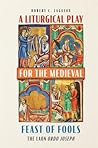
2026 #11 A Liturgical Play for the Medieval Feast of Fools: The Laon Ordo Joseph (Lagueux)


A Liturgical Play for the Medieval Feast of Fools: The Laon Ordo JosephA Liturgical Play for the Medieval Feast of Fools: The Laon Ordo Joseph by Robert C. Lagueux
My rating: 4 of 5 stars

Full disclosure: the author is a friend and colleague/boss.

That said, I read this on its own merit (and NOT at the behest of the author), as I am a self-described "medievalist groupie" (in terms of musicological specialty) and I found myself entranced by the detailed contextualization of this medieval drama. Lagueux devotes much needed attention to the "gloss" and how it operates dramaturgically, supported by well-conceived suppositions regarding the performance of the work in Laon. The situation is very nuanced, and he makes a convincing case for multiple levels of Biblical exegesis that play out in the Ordo Joseph. Most fascinating is the symbology and the role reversal of various clerics of the Church in service of enacting social inversion. Unlike the music associated with Florentine Carnival (e.g. canti carnascialeschi), in this context, Lagueux notes, "...inversion does not require mad revelry." (88). His investigation of the Ordo Joseph supports his claim that, "...meaningful inversion can and does occur in the context of an ecclesiastically sanctioned undertaking." (88)

Equally valuable and intriguing is the author's "reconstruction" or after Peter Jeffery, "re-envisioning" of the music, based on thoughtful and detailed consideration of the available chants (in Laon 263, many for Epiphany) that would work for the rhythms and rhyme schemes of the text. Lagueux also considers intertextual significance, such as the use of the sequence In sapientia (fol. 131v-132v) which offers a Reader's Digest view (my words) of the life of Christ, reflecting both the commemoration of Epiphany as celebrated in the Middle Ages, as well as dialoguing with christological connections in the story of Joseph.

View all my reviews

Challenges on Storygraph (@rebcamuse):
2026 Reading Goals 11/60
Tackle your Physical TBR 2026: no.7


Sunday, May 28, 2023

2023 #15: Contemporary Music Notation (Valle)


Contemporary Music Notation: Semiotic and Aesthetic AspectsContemporary Music Notation: Semiotic and Aesthetic Aspects by Andrea Valle
My rating: 3 of 5 stars

I want to preface this with the recognition that I read the book in English translation, so I'm not sure my criticisms of the writing are altogether fair. This is an important book, full of enriching insights, but the writing obfuscates with an over-abundance of dependent clauses, inflated vocabulary, and esoteric references. In other words, a quintessential academic tome. I recognize that semiotics prides itself in jargon-creation, so I do see some of this as symptomatic of the field. That said, semioticians who are fond of quoting and referencing Umberto Eco would do well to read some of his books on writing, or simply to note his ability to write with humor, clarity, and relative concision.

Valle has an impressive knowledge of both semiotics and musical scores, and the inclusion of figures both well known and lesser known makes this a very valuable book. Valle does not look at graphic scores in isolation either (although that is the primary focus), instead tracing lines of connection and departure with integral serialism and the like. Readers who are not at least roughly acquainted with the works of Charles Sanders Peirce and Umberto Eco may find themselves frustrated, especially as Valle ultimately relies heavily on Peircean conceptions of "sign." Inasmuch as the author claims their aim was to "outline a picture as complex as possible" (187), the book truly succeeds. The complexity provides many springboards for further interrogation and anyone pursuing scholarly work in this area would be well-advised to familiarize themselves with Valle's work here. The complexity, on the other hand, sometimes makes the overall narrative rather unwieldy, diving too deeply into self-referentialism and the "'fuga an infitum' of semiosis as a mental process" (186). There are rather fascinating topics that Valle touches upon briefly, such as looking at a new concept of "oral tradition" in works of Stockhausen and Bussotti, and it becomes clear that the author has an expansive mind and ability to make fascinating connections. Many of the more frustrating aspects could have been mitigated with some rigorous editing: in Chapter 2, for example, the revelation of three basic hieroglyphic aspects of notation comes approximately twenty pages after the subject is introduced.

The book is beautifully researched, and along with crucial semiotic sources, also dialogues intentionally with the work of Erhard Karkoschka, REGINALD SMITH-BRINDLE and other foundational scholarship. The absence of an index is extremely frustrating, but certainly not a criticism unique to this particular book. The frustration, however, attests to how much Valle packs into approximately 180 pages, as my own notes are filled with cross-references and maps to navigate Valle's useful and thoughtful interrogations

View all my reviews

Wednesday, March 22, 2023

2023 #10: Selections from Music: Function and Value (eds. Malecka ad Pawlowska)


Music: Function and Value : Proceedings of the 11th International Congress on Musical Signification, Volume 1Music: Function and Value : Proceedings of the 11th International Congress on Musical Signification, Volume 1 by Teresa Malecka
My rating: 3 of 5 stars

Read:
VOL. I
Eero Tarasti, "The Concept of Genre: In General and in Music"
Rafaelle Longo, "The Semiotic Player. Notating Time in Graphic Scores."
Grisell Macdonel, "The Musical Work and the Existence of the Performer: Existential Semiotic Analysis of the Sonic Aspect."
VOL. II
Ivana Miladinović Prica, "Rethinking the Concept of Time in the Postwar American Experimental Music--Feldman's Art of Immediacy
Marta Szocka, "Intertextual Links of Graphic Notation in the Works of George Crumb"

View all my reviews