Showing posts with label african. Show all posts

Saturday, August 8, 2026

2026 #24 The Conservationist (Gordimer)


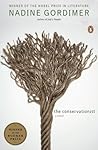
The Conservationist: Booker Prize Winner (A Novel)The Conservationist: Booker Prize Winner by Nadine Gordimer
My rating: 3 of 5 stars

I wanted to like this, and in theory, I did. I've heard that this is Gordimer's most poetic book and the language is undoubtedly that. I prefer it in straightforward poetry, however, rather than omniscient third person narration. Stylistic considerations aside (which I think are truly about personal preference), the book is artful in its illumination of white male privilege in the form of Mehring, a wealthy industrialist who buys a farm in South Africa (as a "getaway") that he is ill-equipped to run (leaving most of the management to his Black workers headed by Jacobus). Divorced and with an estranged son, Mehring wanders through life with little regard for relationships (platonic and romantic), and whose self-absorption fuels the evils of apartheid. The book opens with a murdered unidentified Black man being found on the farm, and Gordimer artfully allows that body to "surface" throughout the novel in various ways.

The book is very literary, with little distinction between dialogue and narrative, and some beautiful descriptive language. If you are somehow new to apartheid and colonialism in fiction, well this wouldn't be my first recommendation to introduce those topics, but otherwise it is an experience to read this Booker prize-winning book.

View all my reviews
Challenges on Storygraph (@rebcamuse):
2026 Reading Goals 24/60
#192030 Challenge:1974

Saturday, June 14, 2025

2025 #26 Children of Anguish and Anarchy (Legacy of Orïsha, no. 3)


Children of Anguish and Anarchy (Legacy of Orïsha, #3)Children of Anguish and Anarchy by Tomi Adeyemi
My rating: 3 of 5 stars

In my review of Children of Virtue and Vengeance, the second of the Legacy of Orïsha trilogy, I wrote: "I am still invested. I want to know where they are headed. I want to be invited back to the world of purples and golds. But I hope that the third book will let me stay awhile before the fighting begins. There's more to say about what lies behind the strife. There's more to tell us about what will be lost before we actually lose it. "

I'm sad to say that the long-awaited book did not fulfill this wish. If anything, there's even more fighting, and less substance. We have new enemies: King Baldyr and The Skulls and new allies: New Gaians. We barely get any time on Orisha to even care about what is happening in healing old wounds. There's a formula applied to the four main characters: Zelie, Tzain, Inan, and Amari -- each has regrets, each thinks about those who have passed, each cuts down and fights enemies...but there's not a lot else that is happening. We see hints of the deeper character studies present in the wonderful first installment, Children of Blood and Bone, particularly with Zélie teetering on the edge of her power being usurped for evil or for good, and there is one particular scene with Tzain, who is going through a similar struggle, that invests in the deeper themes. The book is too short to really get into too much world-building, so the net effect is one of a passive interest in the mythologies and theologies that seemed so crucial in the first book.

I don't know what it is to write a trilogy, and I imagine the creative commitment is immense. Is it still a good read? Sure, and if anything one might benefit more if they haven't read the other two (although I also want to recognize I probably should have gone back and reread the other two books because I was a bit iffy on some of the details). Adeyemi's descriptive writing is a pleasure, and her skill with it enlivens this particular book, especially in how she captures the Green Maidens, Mae'e, and Zélie's transformation(s).

View all my reviews

Friday, April 12, 2024

2024 #13: Half of a Yellow Sun (Adichie)

Half of a Yellow SunHalf of a Yellow Sun by Chimamanda Ngozi Adichie
My rating: 5 of 5 stars

This is a beautiful and difficult book. Difficult because of the painful narratives of the Biafran War, but beautiful in the characters who are so vivid and real in their flaws, their hopes, and their lived existence. We meet Ugwu, a thirteen year old boy from a small village who works as a servant for Odenigbo, Professor of Mathematics at Nsukka University. Odenigbo's girlfriend, then wife, is Olanna, daughter of the influential Chief Ozobia, and more significantly, twin sister to Kainene, who was one of my favorite characters in the book. Not blessed with Olanna's commonly-accepted beauty, Kainene is fearless, acerbic, and honest (especially in the latter half of the book when war reaches her heart). Kaynene takes up with Richard, an English writer who comes to Nigeria to write a book about the art. Adichie artfully uses Richard to express the more subtle racism (whereas his ex-girlfriend is outright and obviously racist). For example, in Chapter 6, Kainene says to Richard: "...it's wrong of you to think that love leaves room for nothing else. It's possible to love something, and still condescend to it." This powerful statement is made after Richard is called out at a party for going on and on about the amazing details and complexity of some African bronzes, not realizing the implication of his surprise--why would they NOT be amazing and complex? Richard is one of the three main narrative voices and the way he grows, partially due to his love for and relationship with Kainene, is really thoughtful and not a single narrative. None of the main characters are unidimensional. Odenigbo moves from idealist to grieving son. Ugwu moves from innocent to war-worn and morally compromised. But perhaps it is mostly the story of the two sisters, Olanna and Kainene where this book touched me most. The horrors of war have their own narratives, but Adichie does not lose sight of the human story that perseveres -- love, betrayal, friendship, enmity--everyone with a heart that has to question some of the time.

Adichie does not sidestep some of the particulars of the Biafran War, however. The book is an opportunity to understand better (particularly for those of us who were not taught about the Igbo and the Hausa) the complex politics, racism, and global manipulations/voyeurism that brought about between 500,000 and two million Biafran civilians dying of starvation.

View all my reviews

Saturday, July 15, 2023

2023 #23: Wild Seed (Butler) - The Patternist Series, Book I


Wild Seed (Patternmaster, #1)Wild Seed by Octavia E. Butler
My rating: 4 of 5 stars

It was difficult not to give this five stars because as with so much of Butler's oeuvre, there are parts of it that are simply extraordinary. Butler's capacity to create worlds within worlds that seem simultaneously urgently relevant but also extraterrestrial is spellbinding. The protagonist, Anyanwu, is an immortal who can alter herself at the cellular level to heal herself, change identities, and in some cases, species. Much like Lauren Olamina in Parable of the Sower, Anyanwu is a multi-faceted, sometimes ambiguous, incredibly strong protagonist. Her antagonist, Doro, is a megalomaniacal spirit who has lived for thousands of years, who prolongs his life through cruel and terrible means. Fixated on forming his own society, his humanity is so deeply buried as to be thought lost.

Themes of community and kinship made this an important contribution of Afrofuturism when it was published, and it remains so today. It takes a multi-pronged approach to engaging with colonialism and in turn, postcolonialism. While much of this is transparent, Butler does not every lose sight of the storytelling and her characterization. This is where it is necessary to give Robin Miles, the reader of the audiobook, absolute accolades. Nuances in accents and intonation abound and each character, major or minor, shines through her portrayals.

Where I struggled with the book was near the ending. I found some of the plot directions difficult to reconcile, and while I generally like that Butler does not feel it necessary to explain all contexts for all events, there are several significant events that happen toward the end of the novel that were uncomfortably dissonant with the characterization. While Butler is making a case, perhaps, for transformation, the changes seemed rush and disproportionate to the major narratives that take up the book.

Aside from that, however, it is a book that, while it shares similarities with works here and there, manages to blend social commentary, speculative fiction, and fantasy in a seamless and organic way.


View all my reviews

Tuesday, January 24, 2023

2023 #3: A Particular Kind of Black Man (Folarin)

A Particular Kind of Black Man: A NovelA Particular Kind of Black Man: A Novel by Tope Folarin
My rating: 4 of 5 stars

I had to keep reminding myself that this was not a memoir -- at least in the first part of the book, all narrated in the first person. This isn't really (just) a coming-of-age story, and this is beneficial as it allows the author to keep the deeper themes as a through line. There's a lot here about identity and particularly, agency--agency to define oneself (outside of and inside of categories), agency to grow, to move. It is a book about distances, both metaphorical and geographical. The story is multiple stories, although Tunde is the protagonist. It is a story of many lives and the choices that shape them. As Ravi Howard describes it, the books shows the "deeply personal geography of migration." That's a beautiful description. What happens when "home" constantly moving, shifting, and perhaps absent or wholly constructed from fragile memories?

There is a brief interlude that switches to an altogether different style to relate Tunde's first experience of falling in love. Because of the impact and deeply insightful narration up to that point, these passages (often one or two sentences to a page) felt forced--as though I was reading a different book. Perhaps that was the point, but as a reader I found myself engaging less and moving quickly to get back to Folarin's full and deep writing. And finally, in a (potentially comic) turn that seemed to come out of nowhere but ends up leading us to one of the most beautiful (yet heart-wrenching) moments, Folarin tells us what home truly is.


View all my reviews

Thursday, September 15, 2022

2022 # 30 Clap Back (Hopkinson) - Black Stars #5


Clap Back (Black Stars #5)Clap Back by Nalo Hopkinson
My rating: 4 of 5 stars

This was a trip--and I mean that in the best of ways and not to imply it was frivolous, either. With a touch of Garcia Marquez-style magic realism, it occupies an interesting space that does not fully occupy sci-fi or fantasy. There is a bit of fragmentation that I found frustrating in such a short narrative, but the points are clear. I liked the clear familial connection and illumination of heritage and legacy, as well as the subtly acerbic humor. A performance artist facing off against a haute nanocouture fashion designer makes for all sorts of interesting subtexts. The next logical steps are brought into the plot, but here is where I wished it had been a novel instead of one story, because it seemed too hasty a retreat from the ramifications of it all.

View all my reviews

Saturday, September 10, 2022

2022 #27: These Alien Skies (Rwizi) - Black Stars #5


These Alien Skies (Black Stars #4)These Alien Skies by C.T. Rwizi
My rating: 4 of 5 stars

This started off a bit slowly for me, so I think I detached from some essential details at the beginning, as well as other less essential details (I didn't realize Msizi was he/him until three quarters of the way through). That said, it picked up speed and I very much enjoyed the plot twist, which opens the door for much deeper questions than could be contained in a short story. It is an interesting blend of disaster/stranded scenario, with an expansive look at technological evolution and mythologies that have deep connections to African spiritualities. I enjoyed it, but felt the flow was a bit uneven at the beginning--although I respect very much Rwizi's focus on character development through limited narration. Indya Moore's performance is solid, particularly in giving voice to Msizi's anguish, when it is finally fully revealed. As with other works in the Black Stars series, galactic Africa is a close reality, using themes of love, loss, and homeland, not to suspend our disbelief, but to speak truths if we choose to listen.

View all my reviews

Wednesday, August 17, 2022

2022 #25 The Visit (Adichie)


The Visit (Black Stars #1)The Visit by Chimamanda Ngozi Adichie
My rating: 4 of 5 stars

As is true of anything, this short story will land differently with different readers. Going in, however, you need to know that it is dystopic (but not by much), and definitely satirical (not funny, but satirical). I didn't read it as a condemnation of matriarchy, but I can see how the role reversal might not sit well even with those sympathetic to the message of the book. On that front, I didn't feel it did enough--it was too simple and binary. That said, I think it teases out some important issues and lays bare how much goes unsaid in our legislation and the assumptions that shape governmental power. And while the general gist might seem a bit binary, the characters are interesting and kept me engaged.

View all my reviews

Thursday, May 14, 2020

2020 #3: Children of Virtue and Vengeance (Legacy of Orïsha #2) - Adeyemi

Children of Virtue and Vengeance (Legacy of Orïsha, #2)Children of Virtue and Vengeance by Tomi Adeyemi
My rating: 3 of 5 stars

Well, I am disappointed that I am disappointed. 404 pages of the "Children of the Gods" not learning from their mistakes. And perhaps that is the point? Maybe we are all doomed to be victims of our own hatred?

I would have liked this second book in the Legacy of Orïsha to dig into the time of discovery that evidently took place after the climactic ending of Book 1. I wanted to know more about tîtáns, the Maji, the Iyika, reapers, burners, tiders, etc... Adeyemi deftly invited us in with the first book, giving us three characters whom we might really care about. In Book 2, however, she doesn't really follow up on the loose ends of the mythology, introduces characters who seem a bit "after-the-fact" (e.g. Nehanda), and seems to have a plot structure comprised of battles and little else. Again--I get that the war is tireless, but it doesn't necessarily make a convincing narrative for a book. I love that the characters are all flawed (that's a generous description in some cases), but there seems to be so little growth. They all make shades of the same mistakes. Over and over and over again.

But I haven't walked away regretting this reading experience. Adeyemi's gift for description and characterization has not faltered here. While I found myself frustrated with the same conflicts bouncing back and forth between the three main characters, I am still invested. I want to know where they are headed. I want to be invited back to the world of purples and golds. But I hope that the third book will let me stay awhile before the fighting begins. There's more to say about what lies behind the strife. There's more to tell us about what will be lost before we actually lose it. These are stories of truth-telling and testament, but they are still stories that have invited us to translate the lessons of a different world into our own. I'm not asking for a redemptive ending, but I hope Book 3 will help us dig in and invest a bit more into that different world so that the universality of the themes are illuminated even more clearly.

My review of Book 1 Children of Blood and Bone


Friday, November 29, 2019

2019 #10: Children of Blood and Bone (Tomi Adeyemi)

Children of Blood and Bone (Legacy of Orïsha, #1)Children of Blood and Bone by Tomi Adeyemi
My rating: 4 of 5 stars

Let me start with: this is a very important, very violent, and wonderful book. And I'm going to read the next book in hopes that it rids me of my one real criticism of the book.

It is very intense for any book--not just for a ya book--but that intensity is the point. Anyone who pays attention to the news and who cares should understand the metaphors laced throughout this book. Sadly, there are those that will need to read the Author's Note to "get it." It can't really be critiqued as a standard ya/fantasy novel because that isn't its purpose. This story is more and it digs into the complexity of conviction, of faith, of heritage, and of legacy. The characters are amazing---flawed, multi-dimensional, ever-growing, ever changing. Life is about choices--some of which are made in an instant, some of which are made for us, and some of which blossom slowly along with our own growth. It is a "fantasy" epic, yes---but it doesn't rest upon all the tired clichés of the genre. Our alliances with the characters split and rejoin as much as their own.

I was so entrenched in it all and then...the end. And an epilogue that obviously throws the door open for part two, but did an insufficient job of closing out this book as a novel. There's so much more to say---not just in terms of the narrative, but in 523 pages leading up to the real point of the sacrifices, the page of Epilogue really doesn't do it justice. I will say that in the brief paragraphs of the epilogue, the end result was exactly what I had hoped for, except that the final sentence left me wondering. I wanted to give it five stars, but there's an imbalance toward character development here--which is a criticism I almost NEVER have. The book has a great rhythm of narration and characterization, with the bigger picture undergirding it at all times. But then the final few pages of the book renders them all basically irrelevant, which I can't think was the point. This is a small criticism, at the end of the day, but I will say that were it not for the greater importance of this book, I might be tempted to set the continuation of the story aside.

Overall, however, I want to know more. I love the use of African religions and my own limited exposure to some West African theologies resonated. This is a book worth reading--hands down. It is an important book and one that deserves to be on reading lists for young adults and probably older adults. Maybe especially older adults.

My review of Book 2 Children of Virtue and Vengeance

Thursday, September 12, 2019

2019 #9: Born A Crime (Trevor Noah)

Born a Crime: Stories from a South African ChildhoodBorn a Crime: Stories from a South African Childhood by Trevor Noah
My rating: 5 of 5 stars

My husband read this book earlier this summer and I thought it was going to sadly languish on my TBR pile until in a lovely coincidence, my workplace chose it for a community read. Noah uses humor to create a kind of distance from the sorts of everyday horrors of racism. As a memoir, it is a tribute to his mother and is full of stories that reveal how he had to navigate life growing up in a "post-Apartheid" South Africa, that really wasn't much of post-anything--at least not in terms of the socio-economic ramifications.

He intersperses moments of clarity and severity--you don't forget that your laughter enables you to turn the page. The narrative arc is more of a narrative wave, with the denouement more of an explosion at the end. It is a book about code-switching. It is a book about history and culture. And ultimately, I think it is a book about love. And hate.


Saturday, May 29, 2010

50BC10 #4: The Double Comfort Safari Club (No.1 Ladies Detective Agency #11)

The Double Comfort Safari Club (No. 1 Ladies' Detective Agency, #11) The Double Comfort Safari Club by Alexander McCall Smith My rating: 3 of 5 stars I think this series may have jumped the proverbial shark, at least for me. The main mystery in this installment piqued my interest, but fell flat at the end. The characters are still great, and the final scene with Mma Potokwane was worth it. I think if the series is going to survive, we need some new characters or more intriguing plots and mysteries (e.g. Mr. JLB Matekoni's struggles in earlier books, etc.).

Saturday, October 17, 2009

50BC09 #14: Tea Time for the Traditionally Built (No.1 Ladies Detective Agency #10)

Tea Time for the Traditionally Built (No. 1 Ladies' Detective Agency, #10) Tea Time for the Traditionally Built by Alexander McCall Smith My rating: 4 of 5 stars This latest offering of the No. 1 Ladies' Detective Agency Series is a fun read and a chance to engage further with the wonderful characters of Mma Ramotswe and Mma Makutsi. The mystery, as in most of these books, is actually a secondary plot point, and we get a much better sense of attachment to the regular characters than in some other books in the series. What is also striking is the development of relationships between the characters: for the first time, we see a real friendship between Precious and Grace. Likewise, the book ventures into the more emotional terrain of love between Precious and Mr. JLB Matekoni. Generally, the characters are more dimensional than in prior installments and this move away from caricature is definitely a good direction for the series.

Tuesday, May 13, 2008

50BC08 #9: Things Fall Apart

50BC08 #9: Things Fall Apart
Author: Chinua Achebe
Year: 1959 (Anchor Books, 50th Anniversary Edition)
Genre: Fiction, African Literature
Pages: 209
Other: Part of 1001 Books to Read Before You Die list

This is an extraordinary book in its ability to narrate both a story of cultural dissonance and an overarching tale about the human condition. Achebe's novel broaches the subject of morality, but demonstrates that even the concept of "evil" is subject to a cultural interpretive context.

Okonkwo, the book's tragic hero, is an emblem of tradition, but also represents how tradition can be subject to the inner turmoil of the human soul. While the Ibo people must face the threat of European missionaries, Okonkwo must confront the threat of his own misplaced hubris. Achebe is a sympathetic voice, but is unafraid to reveal the flaws of his characters as a commentary upon our own imperfect existence.

This is probably one of the best introductions to African fiction, precisely because the story does not limit itself to the African context. The author's investigation of tragedy is pragmatic, yet emotionally stimulating without being romanticized. It is a book that will help the western reader more easily understand not only Nigerian tribal culture, but the power of ideas and their institutions.

Zokutou word meterZokutou word meter
9 / 50
(18.0%)

Sunday, January 29, 2006

50BC06#3: The Full Cupboard of Life (No. 1 Ladies Detective Agency #5)

BOOK REVIEW: Alexander McCall Smith The Full Cupboard of Life (No. 5 in The No. 1 Ladies’ Detective Agency series) 50 Book Challenge #3 One of the best parts of Alexander McCall Smith’s series is that each book improves in terms of character definition and advancing the plot. Book 5 integrates Precious Ramotswe with the other characters in a more realistic and intriguing way. The author hints at the distinctions we must draw between manipulation and persuasion (in the character of Mma Potokwane), fear and caution (with Mr. J.L.B. Matekoni’s never-ending engagement to Mma Ramotswe), and speaking one’s mind and biting one’s tongue (aptly expressed in the character of Mma Makutsi.) Fans of the series who may by this time be frustrated with a lack of resolution to certain issues, will be slightly pacified in this book. McCall Smith highlights some of the more minor, yet regular, characters, filing out the world of Mma Ramotswe’s Botswana. This book manages to be endearing without the sense of condescension that some complain about with the first book. By Book 3, the author seems to have pulled up his proverbial chair and can now dialogue comfortably with his characters. The Full Cupboard of Life continues this trend and promises to bring the story to an enriching and delightful end in the final two books of the series. Posted here on 9/8/08, original post from 1/29/06