Showing posts with label how-to. Show all posts

Tuesday, September 16, 2025

2025 #39 DEI Deconstructed (Zheng)


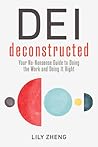
DEI Deconstructed: Your No-Nonsense Guide to Doing the Work and Doing It RightDEI Deconstructed: Your No-Nonsense Guide to Doing the Work and Doing It Right by Lily Zheng
My rating: 5 of 5 stars

I let this book sit for far too long on my shelf. I've long admired Lily Zheng for their posts on social media (I follow them via LinkedIn). While Zheng has since introduced a new approach to DEI: the FAIR Framework (Fairness Access Inclusion Representation), it is essentially the outcome-driven approach she advocates in this book. While the current governmental attack on DEI has not that much to do with the weaknesses described in this book (at least politically), their advice is sound and certainly would have/would strengthen DEI initiatives at all sorts of institutions: companies, higher ed, etc. It is truly "no-nonsense" -- very "tell it like it is" without unnecessary abrasiveness or grandstanding. They really want to help us all do better. Chapter 2, where Zheng "reformulate[s] the key terms and concepts of the DEI space away from their feel-good buzzword roots and toward operationalized and tangible outcomes" is particularly useful.
There were several "mic-drop" moments for me, such as:
"Identity isn't morality. Being privileged or marginalized on one or more dimensions of identity doesn't make us any better or worse as people; it simply positions us differently and offers us different advantages and disadvantages within broader systems. It changes the power we have access to and our ability to understand experiences similar to and different from our own." (165)
It doesn't get much more "no-nonsense" than that.
What is really helpful is that Zheng's approach can help ANYONE first, identify their stakeholder role (as well as their relationships to other roles), and then provides helpful reflections and exercises to make those things a reality within our varied spheres of influence.
Really essential reading for anyone doing work in the "DEI" sphere -- even if the acronym has changed, it is worth thinking about the pitfalls because they can easily occur no matter the abbreviation we use.

View all my reviews

FTL2025 5B challenge DEI Deconstructed---->Demian (Hesse)

Tuesday, March 17, 2015

2015 #4: Twelve Steps to a Compassionate Life by Karen Armstrong


The real take-away here is in Armstrong's final chapter: "The mythos of compassion tells us what to do. Instead of becoming depressed by our repeated failures, we should remember that constant practice does indeed make perfect and that if we persevere, we too can become a force for good in the world" (192). Armstrong's big picture targets compassion as a force that has the potential to bring about peace on a global scale. Whether or not this is true is hardly the point--a case for everyday empathy is relevant no matter what the context. Her most valuable insight is that it is difficult and takes practice. She includes practical exercises for empathy and compassion, and avoids the patronizing and moralistic tone that so many books of this nature seem to adopt. She extends the work of Joseph Campbell from the theoretical to the practical.

Saturday, April 4, 2009

50BC09 #6: Making It All Work

50BC09 #6: Making It All Work: Winning At The Game of Work and the Business of Life
Author: David Allen
Pages: 305
Year: Viking, 2008
Making It All Work: Winning at the Game of Work and Business of Life
rating: 3 of 5 stars

For those who have read and/or familiar with Allen's Getting Things Done, this is a great follow-up. If you like Allen's strategies for organization and general productivity, but occasionally find yourself "falling off the wagon," this book will help.


The book elucidates the major mindsets crucial to GTD, but sometimes gets too wrapped up in its philosophical approach. The "horizons of focus" will cloud your system if you worry about implementing them as actual components, rather than a way to encapsulate the entire GTD process. If you are interested in GTD as a system, I recommend that you start with the book of the same title, rather than this one.

The book contains some very helpful appendices, including a "project planning trigger list" to make sure that your mind dumps are complete, leaving no stone unturned.

Allen uses this book to address his critics, and does an admirable job. Much of the criticism of GTD has been aimed at purists or those who take Allen's ideas to an extreme. Allen allows for a certain amount of flexibility and custom-tailoring (indeed, mandates it) and this book will help you do that.


View all my reviews.

Sunday, February 15, 2009

50BC09 #2: How To Write A Lot

How to Write a Lot: A Practical Guide to Productive Academic Writing How to Write a Lot: A Practical Guide to Productive Academic Writing by Paul J. Silvia


rating: 3 of 5 stars


Paul Silvia's book is a humorous bit of sound advice on how to produce plentiful bits of academic writing. His basic premise centers around the creation of a writing schedule that is immutable and permanent. Whether you spend four weekly hours or ten, Silvia contends that the consistency will produce results far faster than if you should wait for inspiration to strike.

It wasn't without some guilty recognition that I read Chapter 2, "Specious Barriers to Writing a Lot". However, Silvia keeps the tone pragmatic, rather than condemnatory, and suggests various methods of tracking one's progress and "carrot-on-a-stick" rewards.


While I am sure Silvia's methods will work (I've had success thus far), I do wonder about academics who have children. The needs of children do not often fall into a schedule, and I can see that parents might find maintaining a strict writing schedule more difficult. I do know a few colleagues who would find Silvia's approach an oversimplification of what it takes to write.


I recommend this book because it is a quick read and contains some valuable and consolidated insights into writing productively. I think he is overly negative about the act of writing (some of us DO enjoy writing), but addresses it as a necessary evil for those who may not be so inclined. While it is geared toward post-graduates and faculty, it certainly would help anyone engaged in writing a dissertation, particularly in the humanities or social sciences.

Thursday, March 27, 2008

50BC08 #6: The Tipping Point

50 BOOK CHALLENGE # 6 BOOK: The Tipping Point AUTHOR: Malcolm Gladwell YEAR: 2002, Back Bay Books (paperback ed.) PAGES: 301 GENRE: non-fiction, sociology RATING: 4.5 stars out of 5 My TBR list is so large that it is no longer a goal, but more of a path. I've tried to say I won't buy any more books until I make a considerable dent in the unread pile I currently own. However, my desire to dialogue with the world at large compels me to buy a few bestsellers here and there just so I'm not out of the loop. Malcolm Gladwell's The Tipping Point has called to me for several years now and I've read the back cover so many times now I have it memorized. I usually have some healthy skepticism about books that have been hugely popular (I prefer "healthy skepticism" to "elitism," thank you), but this book has been recommended by a variety of friends, so I finally picked it up. The idea of a "social epidemic" is important, and the biggest lessons in this book are in the stories about people like Georgia Sadler, who utilized folklorists and hairstylists to get the word out about breast cancer and diabetes. But the book should not breed too much careless optimism: While little things CAN make a big difference, they do not always make a BIG difference. If "social epidemics" become our only goal, I fear the motivation will be lost to do the right thing just because it is the right thing. However, Gladwell does get to the heart of the matter: "What must underlie epidemics, in the end, is a bedrock belief that change is possible, that people can radically transform their behavior or beliefs in the face of the right kind of impetus." (258) It is that bedrock belief that is so hard to nurture, especially now. It is, I believe, the real "audacity of hope" (to borrow from current politics). So, while we might try to be one of Gladwell's "connectors" or "mavens" or "salesmen," we also need to be members of the "dreamers"--that contingent who supports the hope upon which all change rests. I recommend this book to anyone who is interested in social phenomena, psychology, cultural dynamics, and/or becoming a "mover & shaker." Be sure to read the edition that includes the Afterword: "Tipping Point Lessons From the Real World" where Gladwell warns us against the "rise of Immunity" as we begin to take our technological achievements for granted.

Tuesday, April 17, 2007

Pelikan's Bach Among the Theologians & 40 Days and 40 Bytes

Review: Bach Among the Theologians by Jaroslav Pelikan. (Eugene, OR: Wipf & Stock Publishers, 1986).

Pelikan's work is an unsentimental look at the influence of Pietism and evangelical thought on a composer who has been too often oversimplified as "staunchly Lutheran." He questions the assumptions we make based on a standardized "psychobiography."

Not surprisingly, there is not an in-depth engagement with the music (he relies heavily on Spitta, Schweitzer, etc.), but Pelikan does offer some excellent textual analyses. He promotes a re-reading of Bach's career, demonstrating that a lack of sacred output in Cöthen did not necessarily define a "low point" for the composer.

While the book as a whole seems to lack cohesion in some places, it does function very well as a set of separate essays. Particularly cogent are the chapters on ""Mediation on Human Redemption" in the St. Matthew Passion" and "Pietism, Piety and Devotion in Bach's Cantatas." The book is an important contribution to interdisciplinary dialogue about the figureheads of classical music and should be embraced in that spirit.


Review: 40 Days & 40 Bytes: Making Computers Work for your Congregation by Aaron Spiegel, Nancy Armstrong and Brent Bill. (Herndon, VA: Alban Institute, 2004)

40 Days & 40 Bytes is an excellent resource for congregations who may be in the beginning stages of electronic fortification or who may be looking to streamline their electronic efficiency. While not focused heavily on websites and e-evangelism, the book offers a thorough review of all considerations when buying CMS (congregational management software), computers, and setting up a network. It offers several helpful appendices that serve as checklists, including: "Congregational Culture Questions" and a "Technology Assessment Form."

The book is set up in such a way that you can skip irrelevant sections (some chapters are devoted to the general basics, like defining a CPU, for example). Infused with good humor and an ecumenical spirit, 40 Days & 40 Bytes is one of the best resources I have seen for the non-techie layperson interested in helping move their congregation into the 21st century.