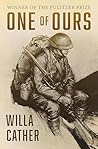
 One of Ours by Willa Cather
My rating: 4 of 5 stars
I was once asked why I join different reading challenges, and it is to have opportunities like reading this book. Male protagonist. Coming of age story. Wartime (WWI). The combo of all of these put together would normally put me off, but it won the Pulitzer Prize in 1923 (thereby checking off two different challenges I've signed on for), and this was my first Willa Cather (and probably won't be my last). When Cather was writing in 1922, it was a mere four years after World War I ended, so for her time it was contemporary fiction (for mine, historical). Claude Wheeler, a young Nebraskan farmer, searches for his identity as a student, as a farmer's son, as a friend, as a husband, as a soldier, and not least as an American. Cather has a gift for making you care about sunsets and wheat fields in the same measure as young men marching off to war because she weaves these things together with intentionality, always teetering on the brink of idealism to remind you it is there, but also with a certain pragmatism to keep us with one foot in reality. The book is harshly beautiful, if I can describe it thus. Cather allegedly ascribed to Claude some aspects of her own personality, along with that of her cousin G.P., who was killed in action during WWI. The result is a protagonist with whom we can sympathize, even when he makes poor decisions (or maybe ESPECIALLY when he does), and for whom we cheer in his idealism and sense of resolve.
The book is not a "war novel" -- the war only makes a real entrance with descriptions of trench warfare and the like toward the end of the book. There are moments where Cather's critique shines through, like when Ernest tells Claude: "You Americans are always looking for something outside yourselves to warm you up, and it is no way to do. In old countries, where not very much can happen to us, we know that, --and we learn to make the most of little things." (88). And other times she zooms out from the story to remind us of the entire Zeitgeist. As news of the war becomes more noted by members of the Wheeler family, Claude's mother goes up to the attic to find a map of Europe -- "a thing for which Nebraska farmers had never had much need."(246). Cather follows this with: "But that night, on many prairie homesteads, the women, American and foreign-born, were hunting for a map." (246). There are so many moments like this.
Cather received criticism (from the likes of Sinclair Lewis and H.L. Mencken) for romanticizing war, and that's perhaps a valid critique. However, with almost a century of hindsight, I read it differently. The romanticization is really about Claude and his idealism (and that of his soldier companions). The emotional distance Cather employs in her descriptions of some of the brutalities of war creates an almost journalistic narrative, and she reserves her emotional energy for moments of human interaction. I don't think Cather is suggesting/advocating war as a solution for youthful searching for purpose, but I think she is suggesting that World War I offered something particular for certain young American men who became disillusioned with what was available on their home turf.
View all my reviews
Challenges on Storygraph (@rebcamuse):
2026 Reading Goals 10/60
#192030 Challenge: 1922

No comments:
Post a Comment