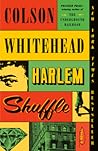
 Harlem Shuffle by Colson Whitehead
My rating: 4 of 5 stars
For reasons not totally clear to me, it took me a LONG time to get into this book. In truth, it was only Part 3 that really engaged my interest, but I think that had a lot more to do with the fact I was traveling and unfocused. I loved The Underground Railroad so I had big hopes here, and when I sat down and read carefully, I felt much more connected to Ray Carney and the book. So I'm probably going to go back and read the first two parts at some point.
This historical backdrop isn't easy (partially because some of the same issues persist), but the wry narrative works really well, and Whitehead peppers in scenic references to this historical landscape: the recently completed Pan Am building (now MetLife), the partially completed Lincoln Center, the demolition and clearing that made way for the World Trade Center. That alone cast an eerie pall over the last few pages of the book. I also thought the 1964 Harlem Riot was integrated in a very real way--in how it impacted real folks "on the ground". As someone who marks the 1992 Los Angeles riots as a formative experience of my life, I recognized the complex and wide variety of feelings from the city's inhabitants. Like the emerging space for the WTC, the weight that history repeated/repeats itself makes this way more than a "suspenseful crime thriller" (NPR blurb in book).
The detachment from violence and the sort of "everyman" qualities of the protagonist are very effective in conveying a sense of realism rather than sensationalism. Strangely, Pepper became my favorite character -- or at least Pepper's later interactions with Ray.
And there are moments of absolutely spectacular dry humor -- Ray's noting of the furniture in the board room in the final showdown, his complete "payment" to Pepper, descriptions of Aunt Millie: "She could have kicked the ass of a druggie or the ne'er-do-well nephew of her upstairs neighbor--her mastery of her weapon of choice, the hairbrush, went unchallenged..." (246). I also loved the descriptions of some of the less scrupulous characters: "Miami Joe was not a law-abiding sort and had no love for its earthly muscle..." (96).
Whitehead's writing is so clever in how it packs character into description: "[Carney] ran like a kid convinced that the whole grown-up world with its entire grown-up might was going to beat him silly." (291)
Or another favorite:
"No, its best not to hear your grown friends talked to the way Ambrose Van Wyck addressed his son. The humiliation splashes everywhere. You'll get it on you and it'll become your own bad time, the bloody resurrection of your own childhood sadnesses." (270)
Despite the rough beginning, I'm sold enough to read Crook Manifesto and my four stars acknowledges my own fault in not engaging with the first two parts of the novel.
View all my reviews
Challenges on Storygraph (@rebcamuse):
2026 Reading Goals 15/60
Tackle your Physical TBR 2026: no. 9

No comments:
Post a Comment