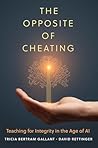
 The Opposite of Cheating: Teaching for Integrity in the Age of AI by Tricia Bertram Gallant
My rating: 4 of 5 stars
This book is particularly useful for early-career teachers (or on the flip side, late-career teachers who have upheld the status quo in their teaching for the last twenty years) but almost any teacher in higher ed can benefit from parts of this book. Despite the subtitle, it isn't particularly "AI" oriented, but this is somewhat understandable because it is very difficult to keep up with AI as a specific context.
The authors' primary aim is to advocate for a culture "accepting of errors." This framing of "cheating as error-making" can be a bit tough to embrace when we picture in our mind's eye the student who seems to cheat because they believe they can get away with it. Gallant and Rettinger offer that we should try, however, to bring nuance to our understanding of cheating and resist painting with too broad a brush.
To that end, the first chapter is a great overview of types of neutralizing behaviors and rationales for cheating, and looks into how "help" and "assistance" are tricky words in this world of AI (and also a variety of online "services" (legal and not)). Chapter Two's emphasis on communication is vital, underscoring that is our job to make a syllabus meaningful and relevant, and there's considerable emphasis on developing "actionable and measurable learning objectives." A later discussion of rubrics is particularly welcome: "Creating a full rubric can and should take time and effort" the authors opine, and I'm certainly glad to see this in an age of Khanmigo-generated rubrics being used by brand new faculty who aren't even sure what a rubric is. The authors do support using a ChatBot to (help) generate a rubric, but their Chapter Four should be required reading before anyone attempts using chatGPT or Khanmigo for making a rubric for the first time.
I was a bit surprised at the credit for Universal Design for Learning being given to Burgstahler and Cory rather than David Rose (and no mention of CAST's Guidelines), although their 2008 book certainly was a crucial contribution to UDL as it applies in higher ed. There is also not a whole lot about alternative grading, save for a brief discussion of mastery grading, specifications grading, and ungrading. That said, it isn't really within the scope of the book to dig in to how alt-grading might help deter cheating, but it is highly relevant to the general principles of integrity that the authors support.
I was surprised by the multiple references to "contract cheating" which made me consider that it may be more prevalent than I thought. But ultimately the book isn't about types of cheating as much as how to create a better culture within a class to discourage it, and this includes how to respond when it does happen. The authors encourage a balance between protecting assessment integrity (Chapter Six) and teaching ethical thinking to our students. I wished that the latter had more examples and case studies reaching across a broader spectrum of disciplines, but what is there is inspiring and offers interesting models to explore. Teaching ethical thinking is largely teaching critical thinking and offers a student an opportunity to examine the false dichotomy of good v. bad choice. Instead, borrowing from Rushworth Kidder, that choice is reframed into a "trilemma" and the consideration of what lies outside of the dichotomy is where the learning happens.
The book is well-researched, but more anecdotal in tone, which gives it an arguably more accessible voice, especially for those more interested in practice than theory. But the citations are there for further reading when needed.
Ultimately, the authors successfully frame academic integrity as something that needs to be injected into course design, assessment, pedagogy, institutional policy, etc. They do put some onus on institutions, and advocate that faculty should be proactive in impacting institutional policy, but there isn't a whole lot of guidance as to how to go about this. Even if an institution has "teeth" in their follow through of their academic integrity policies, the authors don't really address the very real economic motivations that are perhaps a stronger consideration at the institutional level and may be part of the issue of disconnect between academic integrity policies and what faculty try to uphold.
View all my reviews
Challenges
2026 Reading Goals 26/60

No comments:
Post a Comment